 RSS Feed
 Twitter
Water Cube Aquatics Center
Labels: Architecture , Architecture of olympic , olympic , olympic news , Olympic Today , Water Cube , 0 comments
Water Cube The Fantastic Architecture

The Beijing National Aquatics Center also known as the National Aquatics Center better known as the Water Cube is an aquatics center that was built alongside Beijing National Stadium in the Olympic Green for the 2008 Summer Olympics. Ground was broken on December 24, 2003. Despite its nickname, the building is a cuboid, not a cube.
With the year of 2007 approaching, good news came from the construction sites of the Olympic projects -- the membrane structure of the outside layer of the National Aquatics Center, also called the "Water Cube," was completed on the morning of December 26.
The center will be the venue for swimming, diving, synchronized swimming and water-polo final during the Olympic Games.
The blue bubble-wrapped National Aquatics Centre, better known as the “Water Cube”, took four years to build at a reported cost of R1.35-billion, most of it paid for by donations from overseas Chinese.
The squat box-like structure — with three pools below ground level — is made up of a steel skeleton sheathed in a Teflon-like plastic that resembles bubbling water and gives the venue its name.

The structure was designed by an Australian consortium and work started on it 2003.
It stands in contrast to the other key Olympic venue close by — the National Stadium or “Birds Nest”, a curved structure made up of interlocking beams that is scheduled for opening in April or May.
“I am moved and proud,” said Li Aiqing, president of Beijing’s state- owned Asset ManagementCompany , which owns the Water Cube, at an opening ceremony.
“This was a very ambitious project in terms of the construction technology, and a most difficult construction challenge.”
Video:
The eco-friendly structure’s translucent shell allows in sunlight, providing heat and light — and cutting energy use by up to 30percent, according to the Beijing Olympic organising committee.
However, China’s notoriously poor air quality was evident at the ceremony. Parts of the high-tech shell were covered by a film of grit while grime could be seen in the interior membrane of the roof.
The 17000-seat venue will host swimming, diving, synchronised swimming and water polo during the August 8-24 Games and 42 gold medals will be awarded there. It has a 3m deep competition pool, a warm-up pool and a diving pool.
From Thursday, it will stage the six-day China Open, a competition that will serve as a test of the venue ahead of the Olympics.
Olympic organisers have built or refurbished 37 venues, 31 of them in Beijing, which will stage the 28 sports during the Games.
More than half the Beijing venues, including the Water Cube, are concentrated in one small area in the north of the city known as the Olympic Green.
The Beijing venue, covered by a membrane of tough Teflon-like plastic that resembles bubbling water, took four years to build and cost a reported 200 million dollars, largely financed by donations from Chinese living overseas.
It stands close to another Beijing Olympic icon, the National Stadium or "Birds Nest", which is scheduled for completion in April or May.
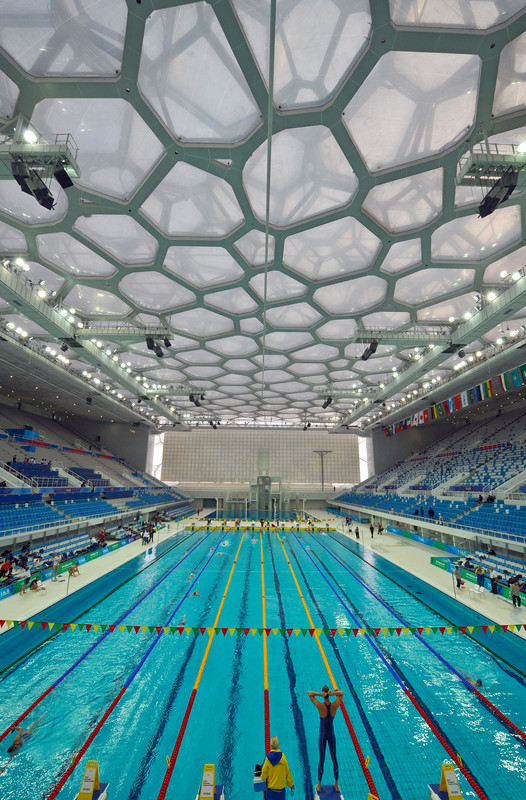
The eco-friendly structure's translucent shell allows in natural sunlight, providing heat and light and cutting energy use by up to 30 percent, according to the Beijing Olympics organising committee.
The 17,000-seater venue will host swimming, diving, synchronised swimming and water polo during the August 8-24 Games.
But its first event will be the six-day China Open, a swimming competition starting Thursday that will serve as a test of the venue.
Organisers have built or refurbished 37 venues, 31 of them in Beijing, to stage 28 sports during the Games.
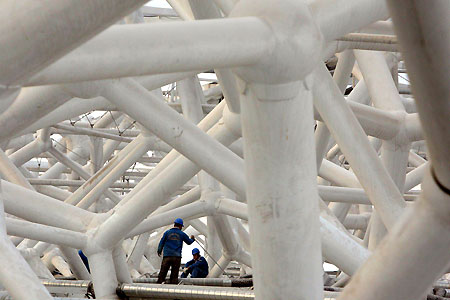
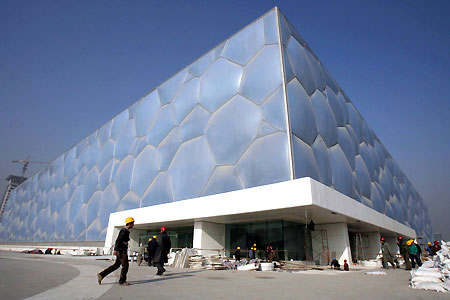
Men work outside the National Aquatics Centre, also known as the Water Cube, in Beijing January 7, 2008. The venue, built for the Beijing Olympics, will host its first event - the "Good Luck Beijing" Swimming China Open - from January 31 to February 5.


