Showing posts with label Technology. Show all posts

Nintendo 3ds Released

Price:$298
Enough with the rumored prices and launch dates for the 3DS already, let's get official. Nintendo just announced a February 26 ship date in Japan for ¥25,000. It'll then land in the US and Europe in March for an undisclosed amount. Launch colors are aqua blue or cosmo black. At a press event in Japan, Nintendo demonstrated the ability to take your picture using the 3DS' front-facing camera and then automatically convert the image into a Mii. You can even merge two photos into a single image if you choose. Images can then be exported as QR codes in wireless "tag mode" or as a file to a bundled 2GB SD card.

Ninty also announced a special edition Super Mario DSi LL set to launch for ¥18,000 in Japan on October 28th. It also confirmed that a Wii Remote Plus is in development and will be announced at a date some time in the future. Finally, a virtual console-style store will serve up downloadable Game Boy and Game Boy Advance games on the 3DS.

Tokyo Flash Unreadable Watch


It is actually possible to read the time. The background is just a bunch of diagonal lines, all running in the same direction. The digits are arranged in a 2×2 square, and are displayed with diagonal lines that run perpendicular to the background. Should you fail to read these digits, or should you just want to find out the time without giving yourself an epileptic episode, press a button on the side and the background is replaced with plain green.

UDS, a Subsidiary of Delivery Technology Solutions

UDS, a Subsidiary of Delivery Technology Solutions, Inc. Announces Extension of the SUBWAY(R) Washington, DC Pilot Agreement

Courtesy :(BUSINESS WIRE)
-- Universal Delivery Solutions (UDS), a division of Delivery Technology Solutions, Inc. (Pink Sheets: DTSL), the leader in delivery management technology, has announced the extension of its agreement with Doctor's Associates Inc. (DAI), the parent of SUBWAY(R) Restaurants. The agreement will continue through December 31, 2010, for the 888-SUB-TO-GO(TM) program pilot that has been operating in the Washington, DC Metro area since Fall 2009. The announcement was made by Ryan Coblin, Delivery Technology Solutions, Inc, Chairman/CEO.
"We are pleased and encouraged by the extension of our agreement with DAI for SUBWAY(R) Restaurants in the Washington area," said Mr. Coblin, "and we view it as affirmation of the success we have had in implementing our proprietary technology and exclusive solutions in and around the nation's capital."
The 888-SUB-TO-GO(TM) services provide the convenience of both toll-free telephone Call Center ordering and Online Ordering at www.888subtogo.com. Customers can order from either the standard SUBWAY(R) menu, or the catering menu that features sandwich platters and giant 6-foot subs, and receive their delivery order, pre-ordered, per their scheduled requirements.
Washington, DC is the eighth largest Nielsen metro market, which includes parts of Northern Virginia and Maryland. Nearly 300 SUBWAY(R) Restaurants are participating in the pilot test program, offering residential and office catering and delivery seven days per week. Since its inception in Washington 888-SUB-TO-GO(TM) has registered a 99% customer approval rating on surveys conducted by the UDS Call Center.
"We are very grateful to the management of DAI for the extension of our mutual agreement," Mr. Coblin explained, "and also to the SDC Development Agent and the Washington market's Franchise Advertising Fund Board for their cooperation in bringing our 888-SUB-TO-GO(TM) services to their customers."
About SUBWAY(R) Restaurants
The SUBWAY(R) chain is the world's largest submarine sandwich franchise, with more than 32,690 locations in 91 countries. The SUBWAY(R) chain has surpassed McDonald's(R) number of locations throughout the USA, Canada, Australia and New Zealand. The SUBWAY(R) chain consistently ranks at the top of Entrepreneur magazine's Franchise 500(R) rankings. Besides being number one for the Submarine Sandwich Category, the SUBWAY(R) chain has received the distinction as being the number one Franchise Opportunity for 19 of the past 23 years! For more information about the SUBWAY(R) chain, visit www.subway.com. SUBWAY(R) and any other marks associated with the SUBWAY(R) Franchise System are the sole property of Doctor's Associates Inc.
About Universal Delivery Solutions
Universal Delivery Solutions, Inc. is the wholly owned subsidiary of Delivery Technology Solutions, Inc. (DTSL), www.deltechsol.com, the leader in providing comprehensive custom-developed catering & delivery solutions to industries throughout North America, including restaurants, retail and others. The company's solutions offer a seamless system that integrates Customer Relationship Management (CRM) and Call Center IT services through a proprietary technology backbone to offer convenience, consistent quality, flexibility, accountability and value for consumers and companies. 888-SUB-TO-GO(TM)is the trademark of Universal Delivery Solutions, Inc.
Safe Harbor:
The statements in the press release that relate to the company's expectations with regard to the future impact on the company's results from acquisitions or actions in development are forward-looking statements, within the meaning of the Private Securities Litigation Reform Act of 1995. The statements in this document may also contain "forward-looking statements" within the meaning of Section 27A of the Securities Act of 1933 and Section 21E of the Securities Exchange Act of 1934. Since this information may contain statements that involve risk and uncertainties and are subject to change at any time, the company's actual results may differ materially from expected results.
SOURCE: Delivery Technology Solutions, Inc.

Most Famous Hubble Telescope Photo in Space

Most Famous Hubble Telescope Photo Images in Space from NASA and European Space Agency

 Hubble Telescope was one of the most vital tool of NASA to observe the space and to pursue further studies in astronomy. What’s make Hubble amazing though was the fact that it was the only telescope ever designed to be serviced in space by astronauts.
Since its launch, the Hubble Telescope had six servicing missions from Space Shuttle Endeavour launched in December 1993 up to the most recent Space Shuttle Atlantis launched last May 2009 capturing over 570,000 images of around 30,000 celestial objects in the universe.


In this Hubble image, the telescope showed pillars of star-forming gas and dust within the nebula.
In addition to the famous photo above, here is an additional exciting image from Hubble Telescope called the “Horsehead Nebula” which resembled that of a horse’s head from the shape of its swirling cloud of dark dust and gases.

Another interesting photo captured by the Hubble Telescope was the “Helix Nebula” which was considered to be among one of the closest nebulae on Earth.

Resembling that of a human eye, the photo of the “Helix Nebula” above has often been referred to as the Eye of God watching us here on planet Earth.
Another magnificent photo caught by Hubble Telescope which is called the “Butterfly Nebula”.

Butterly Nebula is one of the hottest stars located in our own galaxy, Milky Way with an estimated temperature of 220,000 degrees celsius.
Moreover, if you’re familiar with the movie Lord of the Rings, this type of Nebula called the Mystic Mountain from “Carina Nebula” resembles that of the bizaare landscape of the mountain in that movie.

Furthermore, the photo of the “Crab Nebula” considered as the single most interesting object as well as one of the most studied in all of astronomy is shown below:

Finally, here is another famous Hubble Telescope photo which resembles the image of a ghost. Thus, the name “Ghost Head Nebula” is used.


According to NASA, this nebula is one of a chain of star-forming regions lying south of the 30 Doradus nebula in the Large Magellanic Cloud. Two bright regions (the ‘eyes of the ghost’) are very hot, glowing ‘blobs’ of hydrogen and oxygen.
For more space photos which revealed some of the most interesting nebula in space, you can visit  huge collection of Hubble Telescope images here. Alternatively, you can also view some of the videos here. Hubble Telescope is truly one of the best and most advanced invention in space technology.

Gizmodo's iPhone Leak


Gizmodo's iPhone Leak: "We haven't been contacted by law enforcement"

-Courtesy for this post David Murphy

The fat might be hitting the digital pan for Gizmodo, the popular online tech blog that leaked a full set of photos, videos, and descriptions for Apple's rumored fourth-generation iPhone. CNET reported Friday that California authorities are investigating the matter to decide whether Gizmodo's $5,000 purchase of the prototype phone from its source violates California criminal law.
Gizmodo hasn't revealed the seller, the undisclosed patron that found the prototype iPhone left in a Redwood City, CA bar by a 27-year-old Apple engineer.
The investigation was launched after Apple spoke with Santa Clara county police, and Fox News reports that it will likely be under the jurisdiction of the district attorney's office computer crime task force. Nothing has happened yet, however: "We haven't been contacted by law enforcement," said Gaby Darbyshire, chief operating officer of Gizmodo's parent company, Gawker Media, in an interview with Businessweek.
The legal question at hand is whether Gizmodo's purchase violates section 485 of the California Penal Code, which states that, "One who finds lost property under circumstances which give him knowledge of or means of inquiry as to the true owner, and who appropriates such property to his own use, or to the use of another person not entitled thereto, without first making reasonable and just efforts to find the owner and to restore the property to him, is guilty of theft."
According to Gizmodo, the unknown source that found the alleged prototype iPhone attempted to contact Apple by calling the company's support number. He or she was assigned a ticket number, but that's as far as the situation went prior to Gizmodo's unveiling. Beyond that, Gizmodo could potentially face charges if it was found that they knowingly receiving stolen property that was been obtained illegally.
As for the Apple engineer that originally lost the iPhone, Gray Powell has been keeping a low profile in the media throughout this ordeal. CNET interviewed his father, who said that his son "was devastated" regarding the situation. However, there's one small silver lining to the whole ordeal--Nicola Lange, Director of Marketing and Customer Relations for Lufthansa airlines' Americas region, has offered Powell a free business-class trip to Munich, Germany where he could, "literally pick up where you last left off." According to Gizmodo, Powell originally lost the phone at Gourmet Haus Staudt, a German specialty store and beer garden.
Steve Wozniak, Apple's co-founder, has chimed in with his own letter to Gizmodo, indicating that he's heard through his own sources that Powell hasn't lost his job based on the alleged leak.

Israel lifted its iPad ban

Why Israel lifted its iPad ban

Courtesy for this post by Philip Elmer-DeWitt

The official explanation for seizing the devices at the airport never did make sense


On the face of it, Israel's decision Saturday night to allow iPads to be brought into the country was a straightforward reversal of a sensibly cautious import policy.
At least 20 iPads purchased in the U.S. had been seized at Ben-Gurion Airport, confiscated and held in storage for 45 shekels ($12) a day — a fee that now has to be paid by the owner.
The official line is that the Communications Ministry was concerned that the device might disrupt local Wi-Fi networks — including some that might be used by the military. After consulting with Apple (AAPL), an international testing lab and some European communications ministries, the ban was lifted.
But there may be more to it than that. No experts outside (or, for that matter, inside) Israel seemed to be buying the explanation that the ministry was concerned that a device that used American Wi-Fi power standards — rather than the European ones Israel has adopted — could harm the country's wireless networks.
Meanwhile a different, far more cynical explanation was gaining traction. Time magazine on Tuesday picked up a line of reasoning floated five days earlier in TG Daily by Aharon Etengoff, an Israeli-born journalist who spent a year doing public relations for the Israeli Defense Force:

"It is worth noting," Etengoff wrote, "that Apple's Israeli distributor, iDigital, is run by Chemi Peres, the hyper-entrepreneurial son of Israeli President Shimon Peres.
"Clearly, iDigital wants its lucrative cut of every iPad brought into the country — which it will undoubtedly receive when a modified European version of the iPad is approved for import over the next two or three months.
"But in the meantime, iDigital can't make money off the slow trickle of iPads entering the country via private citizens, tourists and international businessmen. (link)
The idea that the money and power at stake would be sufficient to influence Ben-Gurion custom officials seems a stretch. Israel's international boundaries are protected like no other, and its border guards don't need to be told to be extra vigilant with electronic devices. (See Three bullets and a MacBook.)
But even Israeli ministers can be influenced by the weight of international opinion — and we expect, pressure from American high-tech executives used to getting their way.
The order to lift the ban came from Communications Minister Moshe Kahlon. For what it's worth, the word in Israel, according to Haaretz.com, is that Kahlon been not been apprised of the initial decision to ban the iPad because of its Wi-Fi modem.

LHC to uncover dark secrets

Large Hadron Collider to uncover dark secrets soon

Large Hadron Collider to uncover dark secrets soon
Beams of protons circling around opposite directions collided at 7 TeV in the Large Hadron Collider (LHC) at 13.06, Geneva time; a historic moment. Never before man has reached such an energy ever in the history of science. The whole world is rejoicing and the scientific world is jubilant. It is not only a unique and great achievement but March 30 has also opened up a thousand windows of new concepts and new ideas that were until now shrouded in the darkest preserve of the nature.

There was no dearth of anxious moments. Beams started circling the night before without colliding – suddenly around 7 am there was no beam. Something went disastrously wrong. The proton simply refused to be pushed around. After some clever tricks, around 10.30 hours on March 30 the beam came up again.

Higgs Boson, dark matter candidates, source of dark energy, supersymmetric particles – all these fundamental questions are going to be addressed by the LHC. Further when the two nuclei will go on colliding modes shortly, we shall have a glimpse of the universe through the lens of mini bang, a microsecond after the Big Bang.

Technologically, LHC is a marvel at the same time it is the hottest (a million times the temperature of the interior of the Sun) as well as the coldest place (a couple of degrees Kelvin) in the universe, even colder than the microwave background radiation encompassing the entire cosmos. It is the hiss of the universe, the reminisce of its very creation in a Big Bang and therefore, the hiss of the expanding universe.

Already, the data coming out of the colliding protons are overflowing the computers at the detectors, ALICE, CMS, ATLAS and LHCb. The invention of GRID computing system, which networks all the computers in TIER 1 and 2 around the world, has been so fantastic that immediately after March 30, the facility has been fully operational. Kolkata VECC & SINP are members of the TIER 2.

Fundamental questions, which have bothered human beigns, are going to be addressed and examined critically – Why there is matter and not antimatter?; Is it possible for all the forces to be grandly unified?; What is the origin of mass?

Indeed when the nuclei collides in the near future and (hopefully) creates a plasma of quarks and gluons (the very fundamental building blocks of nature) we shall have much deeper insight in the very nature of strong interaction, that binds neutrons and protons inside the atomic nucleus.

Guido Tonelli, spokesperson of the CMS experiment says: “We’ll soon address some of the major puzzles of modern physics.” A collaboration spokesperson, Fabiola Gianotti says: “LHC experiments are propelled into a vast region to explore and the hunt begins for dark matter, new forces even new dimensions.”

In ALICE detector, Kolkata, VECC & SINP have made major contributions in terms of Photon Multiplicity Detector (PMD) and the “MANAS” chip of the dimuon spectrometre. Naturally, we are all jubilant to have already collected the newest data that man has ever seen. My friend Jurgen Schucraft, spokesperson of ALICE, puts it very aptly: “This is the moment we have been waiting and preparing for.”

The director general of Cern Rolf Heuer in a typically understated sentence tells us: “It is a great day to be a particle physicist.” Cern will run the LHC for 18-24 months with the objective of delivering enough data to the experiment make significant advances across a wide range of physics channels.

As soon as they have “re-discovered” the known standard model particles, a necessary precursor to looking for new physics, the LHC experiment will start the systematic search for the Higgs Boson. With the amount of data expected, called one inverse femtobarn by physicists, the combined analysis of ATLAS and CMS will be able to explore a wide mass range.

Heuer explains: “The LHC has a real chance over the next two years of discovering supersymmetric particles and possibly giving insights into the composition of about a quarter of the universe.”

“Over 2,000 graduate students are eagerly awaiting data from the LHC experiments,” Heuer says. “The privileged bunch is set to produce the first theses at the new high-energy frontier. Two years of continuous running is a tall order both for the LHC operators and the experiments, but it well worth the effort.”

Clearly, a moment has come when the young can make their mark and may become famous for more than fifteen minutes. I say “The world will not be same again.” I further say, “LHC will bring up man to a very different height scientifically and technologically. The LHC has touched men and women of countries across the world of all ages as never before.”

The writer is former director of Saha Institute of Nuclear Physics and at present Homi Jehangir Bhabha distinguished chair professor at Department of Atomic Energy

LHC discovered !

Beauty with antimatter bottom' created out of pure energy

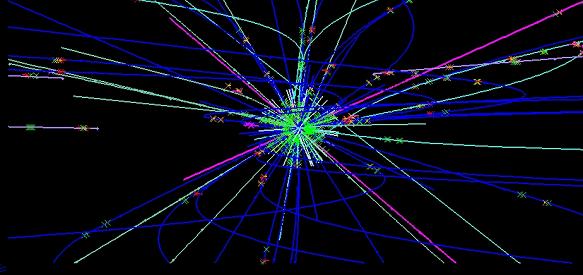
 LHCb Beauty particle collision graphics. Credit: CERN
By Lewis Page • Get more from this author
Physicists at the Large Hadron Collider (LHC), the most powerful particle punisher ever assembled by the human race, say that experiments there are going well. In particular, they have managed to create out of pure energy a thing which they describe as a "beauty" featuring an antimatter bottom.
The unbelievably tiny creation was picked up this week by assiduous boffins trawling through some ten million pics taken by the vast LHCb experiment situated deep underground on the subterranean superchilled superconducting supermagnet proton-ring circuit of the Collider, just outside Geneva.
According to the LHCb scientists:
LHCb has reconstructed its first Beauty Particle! The Beauty Particle (called B+) is composed of an anti-quark b (that has a very short lifetime of 1.5 thousandth of a nanosecond!) and a quark u.
The quark b is known in some circles as a "bottom" quark, so this is plainly an anti-bottom.*
It seems that the B+ beauty was produced by the head-on collision of two protons travelling at light speed, rammed into one another by the crossing of the LHC's twin opposing proton ring beams within the LHCb detecto-cavern complex.
If we're following the scientists' explanation correctly*, the newly created B+ actually had about five times as much mass as the two protons which had crashed into one another to call it into being: in effect, most of the beauty sprang out of nowhere during the collision as the outrageous energies carried by the LHC's colliding particle beams were converted into mass, in a reversal of the process which turns the Sun's matter into sunlight.
"Yes, we can create mass from energy using the famous Einstein formula E=mc2," report the LHCb boffins, with pardonable smugness.
They proved this by working out that the beauty with the antimatter bottom, after travelling about 2 millimetres, exploded and turned into a shower of other subatomic gumble including a Kaon (which is, as any fule kno, one of four types of meson whose strangeness is non-zero) and a thing known as an "excited charmonium". The latter then came to bits again again, as you'd expect, into a muon and an anti-muon.
By some process involving extremely hard sums and possibly some type of reinforced, extremely close-fitting hat to prevent their heads exploding (we could do with one of those just writing about it) the boffins managed to identify all of this on the mad snakes' wedding of particle tracks pictured above and add up how much the original antibottomed beauty had weighed (5.32 Giga-electron-Volts, in case you're wondering) pleasingly confirming that they had indeed summoned matter - and antimatter - into existence using only French and Swiss grid electricity.
Quite apart from being good clean fun, boffins hope that this sort of business will solve the so-called "puzzling antimatter" problem, namely: where is all the antimatter?
According to physics, antimatter and regular stuff should have been created in equal amounts at the Big Bang, yet somehow we've managed to arrive at a universe full of regular-flavour matter and pretty much no antimatter at all.
According to CERN boffins this means that pretty much the whole of physics is wrong, which seems to be pretty much normal for physics:
Since the disappearance of primordial antimatter cannot be explained by the current Standard Model theory, it is clear that we have to look for something new. Scientists are exploring different avenues but, given the fact that what we observe represents only about 4% of the total energy and matter that the Universe is made of, one can guess that part of the key to solving the antimatter mystery could be held in the yet unknown part of the Universe.
Apparently the key to the business involves looking into something called "CP-violation", which is some sort of deviance from normal behaviour on the part of antibottom beauties and their relatives - thus the more of them that can be created at the LHC, the sooner the missing 96 per cent of the universe can be tracked down - perhaps hidden in another dimension or something.

Reebok introduces Smoothfit Technology for NHL Player Jerseys


Reebok is proud to proclaim the first appearance of original NHL All-Star jerseys for referees and linesmen for this year’s momentous NHL All-Star Game, which will be held in Montreal, on Jan. 25. The jerseys -- 18 percent lighter in weight than current officials’ uniforms -- are customized to fit the specific needs of officials, providing increased range of motion and better moisture management. In adding together to the foreword of new official’s jerseys, the jerseys that will be worn by the Eastern and Western meeting NHL All-Stars will include Reebok’s patent-pending Smooth fit act name and numbering technology.
The Montreal Canadians red, white and blue color scheme is in attendance in both the East and West uniforms and celebrates the organization’s 100th birthday. As well, the three stars etched on the players’ sleeves honor the three most-recent NHL All-Star games held in Montreal. “Aesthetically, the design of the 2009 NHL All-Star Eastern and Western Conference uniforms is a deliberate break from traditional hockey uniform patterning and symbolizes the revolutionary advances the sport has made in both technology and popularity.
“In excess of a year ago, the NHL and our on-ice officials began collaborating with Reebok to refresh and update the officials’ uniforms. The results are uniforms that slot in the latest in technology to offer a lighter, extra at ease fit.

NZXT Cryo LX Notebook

NZXT Cryo LX Notebook Cooler Mini-Review

I've become enamored with gaming notebooks, and nowadays, despite the extra expense and the relative lack of upgradeability, I've decided to only buy laptops, and have been doing so for a few years. The thing is, the "hotter" a laptop is, the hotter it is temperature-wise. A notebook cooler is nearly required nowadays.
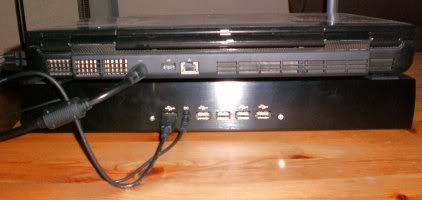

Specs on the cooler from NZXT's site:

  • Built with thick aluminum with sturdy construction
  • Brushed Aluminum finish
  • Rubber finish lifts the notebook up to allow less heat pockets and better airflow
  • Cools your notebook with three adjustable large 120mm fans
  • Four USB ports for your media, storage, and input devices
  • Ability to power devices such as external hard drives.
  • Folding design for easy storage and transportation
  • Support for power notebooks with 15", 17" and 19" wide screens
  • Dimensions (W x D): 16.6" x 11.6"
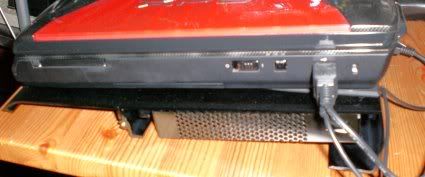
You can see my M1730 fits well on top of the cooler, but the cooler does require two, count 'em two, USB connections. Since the cooler has two ports, you still net two additional ports. You receive one USB cable for data transfer, and one cable that converts from a USB connector to a DC power connection.

The fans aren't exactly high-speed, but they do move a lot of air. There's a speed control dial on the rear RHS of the cooler. It's not too difficult, if you're a tinkerer, to take the unit apart and replace the fans with other 120mm fans if you'd like.

Which one is right for me?


There are a few steps you can take in order to choose a good notebook cooler for you.

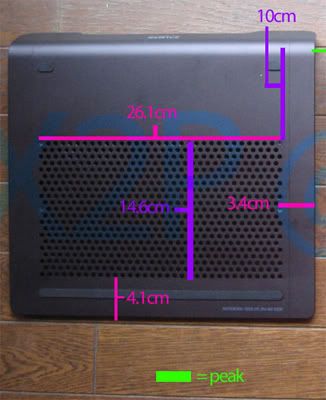
1) The most important thing is the make sure that the vents and fans of the notebook and the notebook cooler align. Raw fan power or CFM (Cubic feet per minute, which is a measure of the volume of air flowing in a system.) is not everything. Alignment of fans and vents will have a bigger role in how effective the cooler is in most cases. Exceptions would be if a notebook does not do well in the presence of any notebook cooler you have tried or if you are having ridiculously high temperatures in specific cases. An example of this would be the Zalman NC1000 versus the Zalman NC2000 debate for a 15.4 inch notebook. After tests were done the lower CFM NC2000 beat out the NC1000 due to the fans and vents being hit better. Here is the link to that article.

Here is an example of how to check alignment.

1) Find the measurements of the vent area or the cooling area of the notebook cooler you are interested in. You could look at reviews or comparisons as they may have measurements already laid out or ask a two or more users of the cooler as they may provide you with the information. The reason you may want to ask two or more users is that one may be biased or they could both have different measurements on what they find to be the area in which airflow comes out and it is recommended if it is the case that two come back with different results find at least one more opinion.


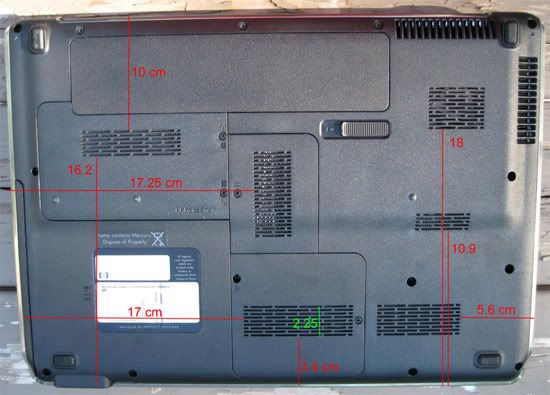
2) Now that you have found the measurements for cooler’s fan/vent location and other measurements flip your notebook over and measure your own vent fan placement. The goal is to see if your notebook will align well with the cooler’s vents. I recommend you take a picture of the bottom and Photoshop or MS Paint the measurements for each location to make it easier for your self after all measurements are taken. If your notebook vents generally hit but only about a centimeter is being missed on top/bottom or both etc it should be fine. (Thank you to the user I have borrowed the image from)


2) Noise. Some do not mind the presence of excess fan noise but there are many who are bothered by almost any noise in general. Many coolers do make a lot of noise but there are some that are quieter then others. One tip is often but note always notebook coolers with higher CFM generate more noise as they either have an extra fan resulting in a 50% raise in noise (mathematically calculating 2 +1 =3, the one is 50% of the 2) or the smaller space in vents to create a higher CFM (Think about blowing through a straw full breath and the noise it would create, now remove the straw and think about that noise which is quieter? No straw).


3) Looks are also important to an extent. Many users want their work space to match and look organized. It is not a good idea if you have an overly sleek notebook such as a new Dell Latitude E and buy a cooler that looks gaming oriented unless it is determined that the cooler will do a far greater job. It would be like taking a Maybach and tossing a racing spoiler on it.


4) Aluminum or a metal in general is a better choice when buying a notebook cooler over plastic for the following reasons. Metal conducts heat, especially aluminum, better then plastic will. Meaning if the contact surface is built out of metal it may provide a better cooling experience. The other advantage of a cooler using its largest surface made out of metal would be strength. Metal is usually stronger than plastic as you should be able to guess.


5) In order to get the best price possible use a site such as:

Canada: www.shopbot.ca
USA: www.pricegrabber.com


Find the lowest price available for the product and find a local store that does price matching. Many stores do this but some require a cash payment in order to allow for price matching.

Red Hat In Desktop Virtualization

Red Hat In Desktop Virtualization


It's hard to know whether there's more than meets the eye with Red Hat (NYSE: RHT)'s acquisition of Qumranet. Yes, it gets expertise in the open source KVM hypervisor, and KVM is the alternative preferred by open source developers. But what can Red Hat actually do with a desktop virtualization product? How's it going to make headway against Citrix XenServer and VMware's Virtual Desktop Infrastructure? There's potential in KVM but is there traction in desktop virtualization for Red Hat?


There's two open source hypervisors now in play: Xen and KVM. Xen has a head start and a lot of major league backers, such as IBM (NYSE: IBM), Oracle (NSDQ: ORCL), Sun and Virtual Iron. But so far it's been more of a vendor-based open source project than a grass roots open source programmer phenomenon. Indeed, each vendor purposely takes open source Xen and goes off and does something unique to it that fits its goals and purposes.


So the standardization that's usually supplied by an open source project gives way with Xen to vendor lock-in initiatives. The cross hypervisor management vendors are quite careful and specific when they say they support Xen--they almost always mean XenSource's XenServer, as the most likely candidate to succeed in the marketplace, and not all the other variations.
Nevertheless, Xen, and in particular, XenSource as part of Citrix (NSDQ: CTXS), have a big head start over KVM and Qumranet in terms of winning desktop virtualization followers. XenSource now has Citrix' credibility behind it in terms of being able to scale up to thousands of end users quickly. Citrix has many years of supplying a connection broker for its Presentation Server. Every desktop virtualization vendor needs a connection broker--hundreds or thousands of end user are likely to call for virtual desktops or application services at the same time. The connection broker manages the traffic within acceptable response times.


That may or may not give it a competitive talking point against XenSource's XenServer. But what about VMware and its Virtual Desktop Infrastructure? It's out there with a lot of its own bells and whistles and the aggressive support of the leading virtualization vendor.
"Qumranet lies squarely in the path of both VMware and Citrix," concluded The 451 Group's virtualization analyst, Rachel Chalmers, as she took a look at Qumranet before it joined the ranks of Red Hat. It still does after the acquisition.


Red Hat's one prospect is to exploit the efficiencies inherent in the hypervisor engine being part of the Linux kernel and hope that that's to ease of use and performance advantages for Qumranet's SolidICE desktop product.


So KVM is inside the kernel, and has the potential to virtualize either Linux or Windows desktops. For now, it's only doing Windows--virtual machines running Windows 2000 or Windows XP, says Red Hat's Mike Ferris and Katrinka McCallum.
KVM may be in the Linux kernel used by open source developers but it's not yet in Red Hat Enterprise Linux; that will likely come with Enterprise Linux Version 6.
So KVM exploit's the kernel's memory management, scheduling and other functions, blending into the heart of what's becoming the workhorse of the Internet, the Linux server. Is that enough to make Red Hat a successful desktop virtualization vendor? Too soon to say, but Red Hat certainly has its work cut out for it.

OpenOffice 3.0 Starts

OpenOffice 3.0 Final to Launch Monday, But You Can Get It Now


OpenOffice.org is throwing a launch party in Paris on Monday, October 13th to mark the eighth anniversary of the open source office software suite and --- simultaneously --- to mark release of version 3.0. The launch event will be sponsored by the Region Ile de France, Silicon Sentier, and OpenOffice. The party is open to everyone, and registration is available online.
Note taking on Writer documents is now much more usableand more ...Open Office 3.0 is Available for the following platforms:
Linux
Mac OS (Intel)
Solaris Sparc
Solaris x86
Windows (32-bit)Can't want for Monday and want it now? There are a few sites such as MajorGeeks hosting the Windows version.In general, though, go to the page listing the OpenOffice.org mirrors, and you can usually find the images in openoffice/stable/3.0.0/on their FTP site. For example, here and here. The cautious can wait until Monday, but the rest of you, start downloading and start playing around with it.
Yesterday, we attended a Business Wire presentation. Business Wire is a Berkshire Hathaway Company (Public, NYSE:BRK.A). Did you know that?! We have used the services of the Business Wire over the years, but that association encouraged us to go - they must be good! We wonder how we missed the Warren Buffet connection. We asked them. We met a couple interesting people and understood just how far removed we were from their world. The topic was Web 2.0 and the tools they have developed to promote their customers as they want to be promoted. We would have shown this, but it may have been too much.

New technology tricks

'Old dog' outstays pups with new technology tricks

http://ftper.newsusa.com/Thumbnail/SundanceSpas_Hydrotherapy.jpg

Wellington production company Gibson Group invented, produced and installed the latest interactive display at Te Papa, a user-controlled media wall as part of the Our Space exhibit.

After more than 30 years in media production, Mr Gibson does not mind being called an old dog, and Gibson Group is one of the more respected in the game.

"We've also got some young pups around the kennel. You do have to reinvent yourself in this business," he says. "There are an awful lot of people my age that have vanished."

With 20 full-timers and at least 100 freelancers in the wings, Gibson Group has grown from Mr Gibson's first projects in the early 1970s. Since then, the competition has at least quadrupled, growing more than the amount of available work, he says.

"The company has changed quite a lot. We have always been pretty good at picking where it [technology trend] is going to go."

Gibson Group turns over about $10 million a year, but the work can fluctuate, with some projects worth up to $5 million, and constantly updating and reinventing can be expensive in a technology-intensive business. Mr Gibson cites a year-old $100,000 piece of kit that is all but gathering dust now.

Rumours of the demise of TV have been around for a while, but new media such as the Web are still working out how to make money to pay for high-quality productions, he says. For all the new tricks, it is basically the same game, he says.

AMD Split Violates License Agreement

Intel Says AMD Split Violates License Agreement

http://www.aurorawdc.com/ci/amd_vs_intel_2.jpg

AMD and Intel are rivals in the marketplace when it comes to x86 compatible CPUs and graphics processors. AMD and Intel have a cross-license agreement in place that allow AMD to use Intel IP to build x86 compatible processors.

On October 7, AMD announced that it was splitting its holdings into two separate companies. AMD will continue as a designer of CPUs and GPUs. The other company is called The Foundry and will be responsible for manufacturing chips for AMD and other companies.

The new company starts with AMD's chip fabs and the chipmaker will retain a 44.4% stake in The Foundry. The remaining 55.6% of The Foundry will be owned by a pair of Abu Dhabi companies that together invested $5.7 billion.

BetaNews reports that Intel issued a statement saying that it will be investigating whether or not the split of AMD and AMD's resulting minority stake in The Foundry violates the heavily redacted licensing agreement that allows AMD to design and manufacture x86 compatible CPUs.

Intel's Chuck Malloy told BetaNews, "We have an obligation to our shareholders that we protect our intellectual property. We want to make sure their interests have been taken into consideration."

AMD for its part believes that it is not in violation of licensing agreements in place between it and Intel. AMD's Michael Silverman told BetaNews, "We are completely confident the structure of this transaction takes into account our cross-license agreements. Rest assured, we plan to continue respecting Intel's intellectual property rights, just as we expect them to respect ours."

According to eWeek, Hans Mosesmann, a financial analyst with Raymond James, believes that Intel could use the split of AMD and transfer of its IP to The Foundry to pressure AMD to drop long-standing lawsuits it has against Intel.

Mosesmann wrote, "AMD, in our view, is likely violating the Intel x86 cross-license, but we suspect Intel may look the other way as it benefits Intel to have an AMD that will over time have increasing variable costs (good for ASPs). Intel may choose to entice AMD to drop the anti-trust suits against Intel in return for this altruistic gesture.”

It appears that Intel is pressuring AMD to release a non-redacted version of the licensing agreement to the public, at this point only the heavily redacted version is available. AMD maintains that releasing a non-redacted version of the license agreement is not going to happen.

AMD spokesman Phil Hughes said, "It’s a business document and we are not going to negotiate this in the press or the media. This is something that the lawyers have to work out.

AMD's Chip Plant Spin-Off

Rumors Swirl Around AMD Chip Plant Spin-Off, New Processor Roadmap Surfaces
Image:AMDMarkham.jpg

Advanced Micro Devices, Inc. (AMD) is an American multinational semiconductor company based in Sunnyvale, California, that develops computer processors and related technologies for commercial and consumer markets. Its main products include microprocessors, motherboard chipsets, embedded processors and graphics processors for servers, workstations and personal computers, and processor technologies for handheld devices, digital television, and game consoles.

AMD is the second-largest global supplier of microprocessors based on the x86 architecture after Intel Corporation, and the third-largest supplier of graphics processing units. It also owns 21 percent of Spansion, a supplier of non-volatile flash memory. In 2007, AMD ranked eleventh among semiconductor manufacturers in terms of revenue.
http://www.slashgear.com/gallery/data_files/2/7/8/amd-logo.png

AMD (Advanced Micro Devices) isn’t in the competitive position against top rival Intel that it once enjoyed. AMD, however, hasn’t given up though and continues to battle Intel for market share. AMD is particularly strong in the server market, especially in the virtualization realm where its technology offers better performance than some of Intel's similar offerings.

In December, AMD will unveil several new Phenom parts. One of them will be a Toliman-based Phenom X3 8850 running at 2.5GHz that will be multiplier unlocked. The roadmap also shows in December a pair of new Deneb-based Phenom quad-core parts. The CPUs will include the a Phenom X4 running at 3.0GHz, and a Phenom X4 running at 2.8GHz. Both of these processors will apparently not hit retail until early January.

AMD is looking to spin-off some of its chip plants Rumors have circulated for a while now. CNET News reports the rumors keep coming up repeatedly due to some truth being in them. Another rumor was started about a possible spin-off recently that cited analyst John Lau with Jefferies & Co who said, "[AMD may] spin-off of its manufacturing operations within two weeks."

CNET News quotes AMD's Drew Prairie saying, "I wouldn't expect an urgent phone call from me in the next two weeks." The implication being that Lau's timing may not be accurate. The chip factories at the heart of the rumors are the pair AMD owns in Dresden, Germany.
http://www.behardware.com/medias/photos_news/00/20/IMG0020524.jpg

Prairie also said, "I wouldn't take that assumption from (analysts) as definitive. There are a lot of nuances and gray areas, as to what we're going to be doing. A lot the speculation is painting things as black and white. I don't think, come announcement day, it will be that black and white."

Prairie also stated again that the chip plant in New York -- which DailyTech reported on in June 2006 -- is a critical part of AMD's manufacturing capability. Other analysts believe that AMD could receive another influx of investment cash to shore up its operations in a manner similar to the $622 million an Abu Dhabi firm paid for an 8.1% stake in AMD in November 2007.


In related news, AMD's Q4 2008 roadmap surfaced today at CHW.net. The roadmap shows new AMD processors are inbound starting on October 8. On that day, AMD will introduce an AMD Athlon X2 5050e Brisbane-based CPU running at 2.6GHz. The same day AMD shows a new Phenom X3 8850 running at 2.5GHz debuting.http://images.dailytech.com/nimage/9165_large_amdq42008map.jpg

In November, AMD will introduce AMD Ultra-Value Client (UVC) solutions that are direct OEM products only. In the consumer space AMD will announced a new Lima-based Athlon 2650e at 1.6GHz. A new Brisbane-based Athlon X2 3250e running 1.5GHz will also be introduced in November.

How to become Invisible

How to become Invisible..

A cloaking illusion. Technology developed by Susumu Tachi in Japan. Consists of a very reflective material capable of displaying a 3d image. The cloak is made off reflective bead material which bends the light. The light that is supposed to be reflected right back at the object is instead bending to the front of the cloak which shoots it at the person looking which makes the illusion of you looking through the person.


Invisible
Monday's big news that the highly respected (and, when you think about it, rather boastfully named) journals Science and Nature will publish two separate papers this week on new advances in cloaking technology is exciting stuff for anyone who, like me, believes steadfastly in the promise of the future. But even futurists have to take a double shot of reality and a pint of skepticism when we see a headline like "Science Close to Unveiling Invisible Man." The research teams from the University of California at Berkeley's Nanoscale Science and Engineering Center are, indeed, talking about the scientific study of making stuff disappear.

how to become invisible

The future, however, arrives with each new day, and this new research out of California brings us closer than we've ever been to disappearing. The Potter Pattern, if you will, has a lot to do with a new round of metamaterials (those made of nanostructures smaller than the wavelengths of light that they deflect) that now are capable of dealing with visible light. Metamaterials work because they don't reflect or absorb light. Instead, they allow light to bend around a three-dimensional object and come out the other side—effectively making everything in between invisible.
how to become invisible

become invisible

become invisible

become invisible

become invisible

become invisbile

how to become invisible

USB Mini Fridge

USB Mini Fridge keeps the dorks coolHave you ever think of having a cool can drink in your office? I'm sure not all the offices have a fridge at their pantry, especially for those small office. Or when you are playing your favorite games at your desktop for hours, and you don't want your chill soft drink to turn into a weird-ghastly-warm drink.

We know you've been waiting for it. Now finally, Brando brings you the $33 USB Mini Fridge. Sure, it takes 5 minutes to bring the fridge down to 8.5 degre es centigrade (47 degrees fahrenheit) and it holds just one can. But hey, it's a 5V USB-powered refrigerator dambit and that's worth it at any price.


Some other features:
  • Cools a beverage from 5V USB Power
  • Temperature of cooling pad decreases to 8.5 degrees after 5 mins
  • The fridge will hold a standard 330ml can. ( Better to make it bigger so that it can hold a mug)
  • Blue LED lighting effects. ( Does it really useful? )
  • No batteries required.
  • Plug and play
  • Size: 19 x 8.5 x 8.5cm.
  • Weight: 362g
Novelty Design
While not the first USB beverage cooler to hit the market, DreamCheeky's USB Fridge is one of the more attractive models to choose from, mostly because it looks like a bona-fide 1950's refrigerator. As such, not only can it prevent sunlight from warming the aluminum housing of our caffeinated goodness, but the magnetically sealed door can keep the cold air close to the can instead of circulating it with the warm air blown from the back of a laptop. While this probably aids the cooling slightly, I wouldn't count on it being as effective as the traditional 6-can mini fridges since the walls and door lining aren' t insulated.

Adding to the novelty effect, inside the USB fridge you'll find a single blue LED to light up the one can interior, the cables to which are stealthily hidden from view in red sheathing. At the base of the interior is a standard cold plate that's similar to what we've seen over a year ago with the USB Beverage Chiller from CoolIT Systems.

The one obvious downside to the enclosure is its in

ability to house any drinks larger than your standard 12oz can. This means you're going to have to just keep on fast-chugging your 500mL water bottles, 16oz "tallboy" energy drinks, 24oz "master cylinder" beer cans, 32oz plastic Taco Bell cups and 10oz glass Bawls bottles, unless of course you're willing to desecrate their sanctity with ice. Ugh. As an alternative coffee drinker that habitually brings in a can of Monster to my day job, this can be quite an issue.

USB Cooling System

Like the CoolIT Chiller and practically all portable refrigeration systems such as those advertised for use in the car, DreamCheeky's USB Fridge employs thermoelectric cooling, based on the Peltier effect. In layman's terms, the Peltier effect is what happens when electrical current is passed through two different metal alloys, causing heat to be transferred from one junction to another, essentially making one side get hot while the other gets cold. While not nearly as powerful or energy efficient as a conventional refrigerator with a compressor, the low cost, size and durability of the thermoelectric cooler has found it a solid niche chilling soft drinks, not to mention cooling our satellites in space.

The effectiveness of the thermoelectric cooler (TEC) is determined by two primary factors: how much electrical current the system is being fed, and how quickly heat can be removed from the hot junction. For the heat removal, an aluminum heatsink (much like what's probably inside your computer) disperses heat from the hot junction, and is aided by a small 80mm fan that sucks air from the bottom of the USB fridge and blows it over the heatsink and out through the vents on the front and back of the unit.

Current draw is the larger of the two issues, since USB is only spec'ed to provide 500mA of juice at 5 volts. Thankfully most desktops and laptops will provide more amperage than this if necessary, but even then the cooling potential will still be inferior to what larger TEC's can accomplish with a car's 12v outlet. And while it didn't happen to my two systems, there's always the potential to overload your USB ports, so it's preferable to play it safe and connect the fridge to a powered USB hub. Contrary to what the manual says, a Mac or PC with 32MB of RAM and 100MB of disk space is not required to power the USB fridge - there's no data connection whatsoever.

Intel's Core 2 Extreme & Core 2 Duo

Intel's Core 2 Extreme & Core 2 Duo: The Empire Strikes BackThe architecture is called Core, processor family is Core 2, the product names are Core 2 Duo and Core 2 Extreme. In the past we've talked about its architecture and even previewed its performance, but today is the real deal. We've all been waiting for this day, the day Intel lifts the last remaining curtain on the chip that is designed to re-take the performance crown from AMD, to return Intel to its days of glory.

But make no mistake, what you see before you is not the power hungry, poor performing, non-competitive garbage (sorry guys, it's the truth) that Intel has been shoving down our throats for the greater part of the past 5 years. No, you're instead looking at the most impressive piece of silicon the world has ever seen - and the fastest desktop processor we've ever tested. What you're looking at is Conroe and today is its birthday.

Intel's Core 2 launch lineup is fairly well rounded as you can see from the table below:

CPU Clock Speed L2 Cache
Intel Core 2 Extreme X6800 2.93GHz 4MB
Intel Core 2 Duo E6700 2.66GHz 4MB
Intel Core 2 Duo E6600 2.40GHz 4MB
Intel Core 2 Duo E6400 2.13GHz 2MB
Intel Core 2 Duo E6300 1.86GHz 2MB

As the name implies, all Core 2 Duo CPUs are dual core as is the Core 2 Extreme. Hyper Threading is not supported on any Core 2 CPU currently on Intel's roadmaps, although a similar feature may eventually make its debut in later CPUs. All of the CPUs launching today also support Intel's Virtualization Technology (VT), run on a 1066MHz FSB and are built using 65nm transistors.

The table above features all of the Core 2 processors Intel will be releasing this year. In early next year Intel will also introduce the E4200, which will be a 1.60GHz part with only a 800MHz FSB, a 2MB cache and no VT support. The E4200 will remain a dual core part, as single core Core 2 processors won't debut until late next year. On the opposite end of the spectrum Intel will also introduce Kentsfield in Q1 next year, which will be a Core 2 Extreme branded quad core CPU from Intel.

Core 2 Extreme vs. Core 2 Duo

Previously Intel had differentiated its "Extreme" line of processors by giving them larger caches, a faster FSB, Hyper Threading support, and/or higher clock speeds. With the Core 2 processor family, the Extreme version gets a higher clock speed (2.93GHz vs. 2.66GHz) and this time around it also gets an unlocked multiplier.

In other words, you can adjust the clock multiplier higher or lower than 11.0x, which hasn't been possible on a retail Intel chip for several years. By shipping the Core 2 Extreme unlocked, Intel has taken yet another page from AMD's Guide to Processor Success. Unfortunately for AMD, this wasn't the only page Intel took.

Scientists puzzling with Martian soil

Scientists puzzling over chemical found in Martian soil

Scientists working with NASA's Phoenix Lander are reasonably sure they have detected a toxic chemical in the soil near the north pole of Mars.

The Phoenix lander's inverted scoop prepares to take soil samples on Mars in this undated image.

But they say hearty strains of microbes might be able to live there anyway -- and even thrive on it.

"This is an important piece of the puzzle as we attempt to determine whether habitable conditions exist for microbes on Mars," said Phoenix principal investigator Peter Smith, of the University of Arizona. "In itself, it is neither good nor bad for life."

The chemical, perchlorate, is an oxidant widely used in solid rocket fuel, but can also be naturally occuring on Earth. It is found in soil of Chile's barren Atacama desert -- generally believed to be one of the most lifeless places on Earth -- but scientists have been able to isolate strains of bacteria living in that soil.

Such organisms are known as "extremophiles," because they have evolved to live in harsh environments. And if it could happen on Earth, why not Mars?

"This desert is a hyper-arid environment that rarely sees rain, and has no vascular plants, and is often used by scientists as a matter of fact as a Martian 'analog' site," Smith said Tuesday.

"These compounds are quite stable in soil and water and do not destroy organic materials under normal circumstances. In fact there are species of perchlorate-producing microbes that live on the energy provided by this oxidant."

Part of the NASA rocket that launched Phoenix to Mars contains ammonium perchlorate, and the team has called in a propellant expert to explore whether or it somehow could have contaminated the science instruments during launch. They consider that possibility remote, however, Smith said.

The Phoenix lander's inverted scoop prepares to take soil samples on Mars in this undated image.Researchers are still puzzling over the results, and say they have as many questions as answers right now about what this all means. More data collection, analysis, and review is needed, Smith said.

The team likely would not have announced these results at this time, but Smith said they felt compelled to speak out to squelch inaccurate rumors circulating on the Internet that the White House had been briefed on a significant breakthrough having to do with life on Mars.

"It's not the way we'd prefer to do it," he said. "Unfortunately there was a story out that we were hiding something, and of course as soon as that story goes out people speculate. The speculation leads to all kinds of wonderful stories of discoveries that I wish we'd made, but we haven't."

Even if it turns out perchlorate in the soil makes it unlikely that life could exist there, it does not rule out the possibility that life once existed in the distant past. It is also possible that subsurface life exists there now, perhaps in a deep underground aquifer.

The chemical, perchlorate, is an oxidant widely used in solid rocket fuel, but can also be naturally occuring on Earth. It is found in soil of Chile's barren Atacama desert -- generally believed to be one of the most lifeless places on Earth -- but scientists have been able to isolate strains of bacteria living in that soil.

IBM and ILOG Announce Future Plans

IBM and ILOG Announce Future Plans

IBM and ILOG have signed an agreement proposition allowing ILOG to be implemented by way of concurrent cash public tender offers in both France and the United States. IBM will combine its business process management (BPM), business optimization, and service oriented architecture (SOA) technologies with ILOG's Business Rules Management Systems software. This will enable IBM to help clients deliver critical business information in real-time, allowing them to make better business decisions faster.

The cash tender offer will be at a price of 10 per ordinary share and the U.S. dollar equivalent per American Depositary Share ("ADS") based on the Euro/U.S. dollar exchange rate as of the settlement of the tender offers, amounting to an aggregate purchase price of approximately 215 million or approximately $US340 million on a fully diluted basis.

When completed, the acquisition of ILOG will strengthen IBM's BPM and SOA position by providing customers a full set of rule management tools for complete information and application lifecycle management across a platform including IBM's WebSphere application development and management platform.

powered by Blogger | WordPress by Newwpthemes | Converted by BloggerTheme