Showing posts with label Technology News. Show all posts

Nokia's newest smartphone revealed

It's the Nokia N8, and it's the first Nokia phone to feature a multi touch screen and Nokia's new Symbian 3 software.  Those terms may not mean much to the casual observer, but industry pundits have been waiting for Nokia to pull something special out of the bag for quite a while.
The world's largest phone manufacturer has struggled to win headlines in recent years as competitors like Apple and Samsung have captured the imagination of the smartphone buying public.
Nokia's challenge has been to release a product that not only sported the high quality hardware for which the company is famous, but one that also delivered a seamless software experience that customers have come to expect from their smartphone's.

There was very little interference on the audio from a clip of an outdoor ice skating scene.
What else? It has a xenon flash, a 3.5 inch touch screen, Dolby Digital Sound, 16 gigabytes of onboard storage and Wi-Fi. It will work on all of the main carriers in New Zealand though distribution details have yet to be announced.
On the software front, the Symbian 3 software is a big step up from the previous iteration.
Like a lot of Nokia admirers I was very disappointed with the software experience with last year's flagship phone, the N97.

It appears that Nokia are keen to iron out any potential bugs however, announcing today that the phone will ship worldwide in October (rather than late September) while they do "some final amends."
Physically the phone is encased in an aluminium body which gives it a semi-rugged look.
The design, and the price - expected to be under $799 - indicate that the phone is being pitched at the middle of the market.
This is a pleasant surprise. Other, less highly specified Nokia phones have sold for quite a bit more, in the $1000 plus range where the iPhone and Samsung Galaxy S are positioned.
It is available in a range of colours overseas, though New Zealand will only get the silver and black models in the first instance.
Overall, Nokia has delivered an exceptional phone at what should be an attractive price.

NZXT Cryo LX Notebook

NZXT Cryo LX Notebook Cooler Mini-Review

I've become enamored with gaming notebooks, and nowadays, despite the extra expense and the relative lack of upgradeability, I've decided to only buy laptops, and have been doing so for a few years. The thing is, the "hotter" a laptop is, the hotter it is temperature-wise. A notebook cooler is nearly required nowadays.

Specs on the cooler from NZXT's site:

  • Built with thick aluminum with sturdy construction
  • Brushed Aluminum finish
  • Rubber finish lifts the notebook up to allow less heat pockets and better airflow
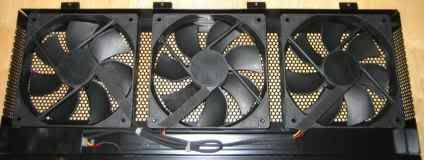
  • Cools your notebook with three adjustable large 120mm fans
  • Four USB ports for your media, storage, and input devices
  • Ability to power devices such as external hard drives.
  • Folding design for easy storage and transportation
  • Support for power notebooks with 15", 17" and 19" wide screens
  • Dimensions (W x D): 16.6" x 11.6"
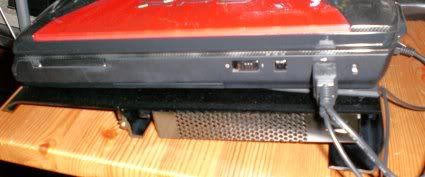
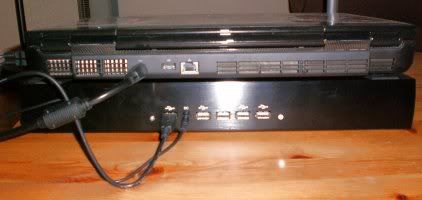
You can see my M1730 fits well on top of the cooler, but the cooler does require two, count 'em two, USB connections. Since the cooler has two ports, you still net two additional ports. You receive one USB cable for data transfer, and one cable that converts from a USB connector to a DC power connection.

The fans aren't exactly high-speed, but they do move a lot of air. There's a speed control dial on the rear RHS of the cooler. It's not too difficult, if you're a tinkerer, to take the unit apart and replace the fans with other 120mm fans if you'd like.

Which one is right for me?


There are a few steps you can take in order to choose a good notebook cooler for you.

1) The most important thing is the make sure that the vents and fans of the notebook and the notebook cooler align. Raw fan power or CFM (Cubic feet per minute, which is a measure of the volume of air flowing in a system.) is not everything. Alignment of fans and vents will have a bigger role in how effective the cooler is in most cases. Exceptions would be if a notebook does not do well in the presence of any notebook cooler you have tried or if you are having ridiculously high temperatures in specific cases. An example of this would be the Zalman NC1000 versus the Zalman NC2000 debate for a 15.4 inch notebook. After tests were done the lower CFM NC2000 beat out the NC1000 due to the fans and vents being hit better. Here is the link to that article.

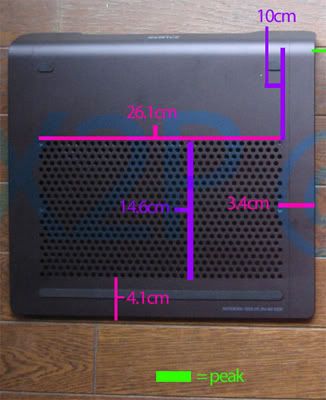
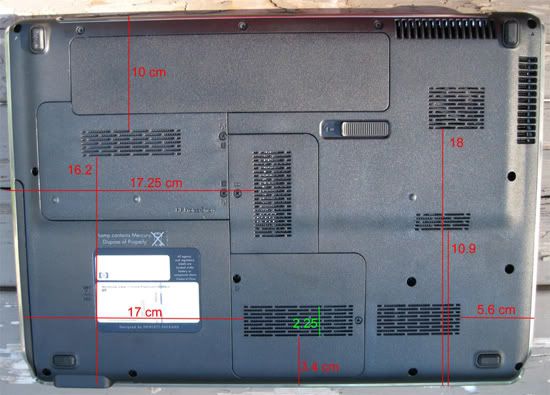
Here is an example of how to check alignment.

1) Find the measurements of the vent area or the cooling area of the notebook cooler you are interested in. You could look at reviews or comparisons as they may have measurements already laid out or ask a two or more users of the cooler as they may provide you with the information. The reason you may want to ask two or more users is that one may be biased or they could both have different measurements on what they find to be the area in which airflow comes out and it is recommended if it is the case that two come back with different results find at least one more opinion.


2) Now that you have found the measurements for cooler’s fan/vent location and other measurements flip your notebook over and measure your own vent fan placement. The goal is to see if your notebook will align well with the cooler’s vents. I recommend you take a picture of the bottom and Photoshop or MS Paint the measurements for each location to make it easier for your self after all measurements are taken. If your notebook vents generally hit but only about a centimeter is being missed on top/bottom or both etc it should be fine. (Thank you to the user I have borrowed the image from)


2) Noise. Some do not mind the presence of excess fan noise but there are many who are bothered by almost any noise in general. Many coolers do make a lot of noise but there are some that are quieter then others. One tip is often but note always notebook coolers with higher CFM generate more noise as they either have an extra fan resulting in a 50% raise in noise (mathematically calculating 2 +1 =3, the one is 50% of the 2) or the smaller space in vents to create a higher CFM (Think about blowing through a straw full breath and the noise it would create, now remove the straw and think about that noise which is quieter? No straw).


3) Looks are also important to an extent. Many users want their work space to match and look organized. It is not a good idea if you have an overly sleek notebook such as a new Dell Latitude E and buy a cooler that looks gaming oriented unless it is determined that the cooler will do a far greater job. It would be like taking a Maybach and tossing a racing spoiler on it.


4) Aluminum or a metal in general is a better choice when buying a notebook cooler over plastic for the following reasons. Metal conducts heat, especially aluminum, better then plastic will. Meaning if the contact surface is built out of metal it may provide a better cooling experience. The other advantage of a cooler using its largest surface made out of metal would be strength. Metal is usually stronger than plastic as you should be able to guess.


5) In order to get the best price possible use a site such as:

Canada: www.shopbot.ca
USA: www.pricegrabber.com


Find the lowest price available for the product and find a local store that does price matching. Many stores do this but some require a cash payment in order to allow for price matching.

Red Hat In Desktop Virtualization

Red Hat In Desktop Virtualization


It's hard to know whether there's more than meets the eye with Red Hat (NYSE: RHT)'s acquisition of Qumranet. Yes, it gets expertise in the open source KVM hypervisor, and KVM is the alternative preferred by open source developers. But what can Red Hat actually do with a desktop virtualization product? How's it going to make headway against Citrix XenServer and VMware's Virtual Desktop Infrastructure? There's potential in KVM but is there traction in desktop virtualization for Red Hat?


There's two open source hypervisors now in play: Xen and KVM. Xen has a head start and a lot of major league backers, such as IBM (NYSE: IBM), Oracle (NSDQ: ORCL), Sun and Virtual Iron. But so far it's been more of a vendor-based open source project than a grass roots open source programmer phenomenon. Indeed, each vendor purposely takes open source Xen and goes off and does something unique to it that fits its goals and purposes.


So the standardization that's usually supplied by an open source project gives way with Xen to vendor lock-in initiatives. The cross hypervisor management vendors are quite careful and specific when they say they support Xen--they almost always mean XenSource's XenServer, as the most likely candidate to succeed in the marketplace, and not all the other variations.
Nevertheless, Xen, and in particular, XenSource as part of Citrix (NSDQ: CTXS), have a big head start over KVM and Qumranet in terms of winning desktop virtualization followers. XenSource now has Citrix' credibility behind it in terms of being able to scale up to thousands of end users quickly. Citrix has many years of supplying a connection broker for its Presentation Server. Every desktop virtualization vendor needs a connection broker--hundreds or thousands of end user are likely to call for virtual desktops or application services at the same time. The connection broker manages the traffic within acceptable response times.


That may or may not give it a competitive talking point against XenSource's XenServer. But what about VMware and its Virtual Desktop Infrastructure? It's out there with a lot of its own bells and whistles and the aggressive support of the leading virtualization vendor.
"Qumranet lies squarely in the path of both VMware and Citrix," concluded The 451 Group's virtualization analyst, Rachel Chalmers, as she took a look at Qumranet before it joined the ranks of Red Hat. It still does after the acquisition.


Red Hat's one prospect is to exploit the efficiencies inherent in the hypervisor engine being part of the Linux kernel and hope that that's to ease of use and performance advantages for Qumranet's SolidICE desktop product.


So KVM is inside the kernel, and has the potential to virtualize either Linux or Windows desktops. For now, it's only doing Windows--virtual machines running Windows 2000 or Windows XP, says Red Hat's Mike Ferris and Katrinka McCallum.
KVM may be in the Linux kernel used by open source developers but it's not yet in Red Hat Enterprise Linux; that will likely come with Enterprise Linux Version 6.
So KVM exploit's the kernel's memory management, scheduling and other functions, blending into the heart of what's becoming the workhorse of the Internet, the Linux server. Is that enough to make Red Hat a successful desktop virtualization vendor? Too soon to say, but Red Hat certainly has its work cut out for it.

OpenOffice 3.0 Starts

OpenOffice 3.0 Final to Launch Monday, But You Can Get It Now


OpenOffice.org is throwing a launch party in Paris on Monday, October 13th to mark the eighth anniversary of the open source office software suite and --- simultaneously --- to mark release of version 3.0. The launch event will be sponsored by the Region Ile de France, Silicon Sentier, and OpenOffice. The party is open to everyone, and registration is available online.
Note taking on Writer documents is now much more usableand more ...Open Office 3.0 is Available for the following platforms:
Linux
Mac OS (Intel)
Solaris Sparc
Solaris x86
Windows (32-bit)Can't want for Monday and want it now? There are a few sites such as MajorGeeks hosting the Windows version.In general, though, go to the page listing the OpenOffice.org mirrors, and you can usually find the images in openoffice/stable/3.0.0/on their FTP site. For example, here and here. The cautious can wait until Monday, but the rest of you, start downloading and start playing around with it.
Yesterday, we attended a Business Wire presentation. Business Wire is a Berkshire Hathaway Company (Public, NYSE:BRK.A). Did you know that?! We have used the services of the Business Wire over the years, but that association encouraged us to go - they must be good! We wonder how we missed the Warren Buffet connection. We asked them. We met a couple interesting people and understood just how far removed we were from their world. The topic was Web 2.0 and the tools they have developed to promote their customers as they want to be promoted. We would have shown this, but it may have been too much.

New technology tricks

'Old dog' outstays pups with new technology tricks

http://ftper.newsusa.com/Thumbnail/SundanceSpas_Hydrotherapy.jpg

Wellington production company Gibson Group invented, produced and installed the latest interactive display at Te Papa, a user-controlled media wall as part of the Our Space exhibit.

After more than 30 years in media production, Mr Gibson does not mind being called an old dog, and Gibson Group is one of the more respected in the game.

"We've also got some young pups around the kennel. You do have to reinvent yourself in this business," he says. "There are an awful lot of people my age that have vanished."

With 20 full-timers and at least 100 freelancers in the wings, Gibson Group has grown from Mr Gibson's first projects in the early 1970s. Since then, the competition has at least quadrupled, growing more than the amount of available work, he says.

"The company has changed quite a lot. We have always been pretty good at picking where it [technology trend] is going to go."

Gibson Group turns over about $10 million a year, but the work can fluctuate, with some projects worth up to $5 million, and constantly updating and reinventing can be expensive in a technology-intensive business. Mr Gibson cites a year-old $100,000 piece of kit that is all but gathering dust now.

Rumours of the demise of TV have been around for a while, but new media such as the Web are still working out how to make money to pay for high-quality productions, he says. For all the new tricks, it is basically the same game, he says.

AMD Split Violates License Agreement

Intel Says AMD Split Violates License Agreement

http://www.aurorawdc.com/ci/amd_vs_intel_2.jpg

AMD and Intel are rivals in the marketplace when it comes to x86 compatible CPUs and graphics processors. AMD and Intel have a cross-license agreement in place that allow AMD to use Intel IP to build x86 compatible processors.

On October 7, AMD announced that it was splitting its holdings into two separate companies. AMD will continue as a designer of CPUs and GPUs. The other company is called The Foundry and will be responsible for manufacturing chips for AMD and other companies.

The new company starts with AMD's chip fabs and the chipmaker will retain a 44.4% stake in The Foundry. The remaining 55.6% of The Foundry will be owned by a pair of Abu Dhabi companies that together invested $5.7 billion.

BetaNews reports that Intel issued a statement saying that it will be investigating whether or not the split of AMD and AMD's resulting minority stake in The Foundry violates the heavily redacted licensing agreement that allows AMD to design and manufacture x86 compatible CPUs.

Intel's Chuck Malloy told BetaNews, "We have an obligation to our shareholders that we protect our intellectual property. We want to make sure their interests have been taken into consideration."

AMD for its part believes that it is not in violation of licensing agreements in place between it and Intel. AMD's Michael Silverman told BetaNews, "We are completely confident the structure of this transaction takes into account our cross-license agreements. Rest assured, we plan to continue respecting Intel's intellectual property rights, just as we expect them to respect ours."

According to eWeek, Hans Mosesmann, a financial analyst with Raymond James, believes that Intel could use the split of AMD and transfer of its IP to The Foundry to pressure AMD to drop long-standing lawsuits it has against Intel.

Mosesmann wrote, "AMD, in our view, is likely violating the Intel x86 cross-license, but we suspect Intel may look the other way as it benefits Intel to have an AMD that will over time have increasing variable costs (good for ASPs). Intel may choose to entice AMD to drop the anti-trust suits against Intel in return for this altruistic gesture.”

It appears that Intel is pressuring AMD to release a non-redacted version of the licensing agreement to the public, at this point only the heavily redacted version is available. AMD maintains that releasing a non-redacted version of the license agreement is not going to happen.

AMD spokesman Phil Hughes said, "It’s a business document and we are not going to negotiate this in the press or the media. This is something that the lawyers have to work out.

First beam in the LHC


First beam in the LHC - accelerating science
http://astronomyonline.org/aoblog/images/LHC.jpg
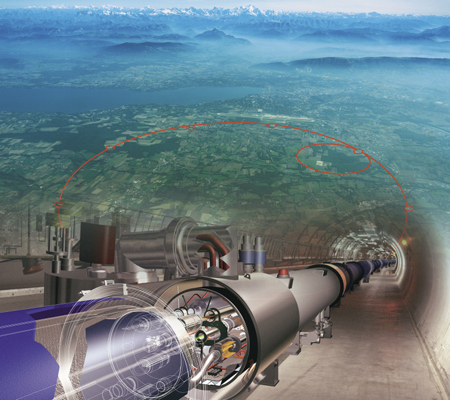
A historic moment in the CERN Control Centre "The beam was successfully steered around the accelerator in Geneva, 10 September 2008."

The first beam in the Large Hadron Collider at CERN1 was successfully steered around the full 27 kilometres of the world’s most powerful particle accelerator at 10h28 in morning at Geneva, 10 September 2008. This historic event marks a key moment in the transition from over 20 years of preparation to a new world of scientific discovery.

The Large Hadron Collider (LHC) — built since 2003 at a cost of $3.8 billion — will provide scientists with much greater power than ever before to smash the components of atoms in a bid to see how they are made.

“It’s a fantastic moment,” said LHC project leader Lyn Evans, “we can now look forward to a new era of understanding about the origins and evolution of the universe.”

Starting up a major new particle accelerator takes much more than flipping a switch. Thousands of individual elements have to work in harmony, timings have to be synchronized to under a billionth of a second, and beams finer than a human hair have to be brought into head-on collision. Today’s success puts a tick next to the first of those steps, and over the next few weeks, as the LHC’s operators gain experience and confidence with the new machine, the machine’s acceleration systems will be brought into play, and the beams will be brought into collision to allow the research programme to begin.
http://graphics8.nytimes.com/images/2007/05/14/science/15cern.xlarge1.jpg
The LHC, as the collider is known, will take scientists to within a split second of a laboratory recreation of the big bang, which they theorize was the massive explosion that created the universe.

The project organized by the 20 European member nations of CERN has attracted researchers of 80 nationalities. Some 1,200 are from the United States, an observer country which contributed $531 million. Japan, another observer, also is a major contributor.

The collider is designed to push the proton beam close to the speed of light, whizzing 11,000 times a second around the tunnel.

Smaller colliders have been used for decades to study the makeup of the atom. Less than 100 years ago scientists thought protons and neutrons were the smallest components of an atom's nucleus, but in stages since then experiments have shown they were made of still smaller quarks and gluons and that there were other forces and particles.

The CERN experiments could reveal more about "dark matter," antimatter and possibly hidden dimensions of space and time. It could also find evidence of the hypothetical particle — the Higgs boson — believed to give mass to all other particles, and thus to matter that makes up the universe.

Some scientists have been waiting for 20 years to use the LHC. But even their younger colleagues are excited that startup has finally arrived.

"I think it's a very important project," said Katie McAlpine, 23, a Michigan State University graduate who made a rap video about the project.

"It's mostly out of scientific curiosity, what is the universe made of? How does it work? What are the rules? That's very exciting and it's important to advance our knowledge," she told Associated Press Television News.

She said she was surprised by the success of the video, which has had more than a million views on YouTube and which has received approval from CERN for its scientific accuracy, especially in its success with young people.

"I was really hoping that this would get taken into classrooms," McAlpine said. "I don't imagine that elementary school and most middle school children will understand it very well, but a lot of parents have e-mailed me, saying I have a 9-year-old or a 7-year-old and showed them your rap and they really love it.


“The LHC is a discovery machine,” said CERN Director General Robert Aymar, “its research programme has the potential to change our view of the Universe profoundly, continuing a tradition of human curiosity that’s as old as mankind itself.”

“I am very honored to visit CERN, an invaluable scientific institution and a shining example what international community can achieve through joint efforts and contribution. I convey my deepest admiration to all the scientists and wish them all the success for their research for peaceful development of scientific progress.”-United Nations Secretary General, Ban Ki-moon said in a visit to CERN shortly before the LHC’s start-up.

“It has been a fascinating and rewarding experience for us,” said Vinod C. Sahni, Director of India’s Raja Ramanna Centre for Advanced Technology, “I extend our best wishes to CERN for a productive run with the LHC machine in the years to come.”

“The completion of the LHC marks the start of a revolution in particle physics,” said Pier Oddone, Director of the US Fermilab. “We commend CERN and its member countries for creating the foundation for many nations to come together in this magnificent enterprise. We appreciate the support that DOE and NSF have provided throughout the LHC's construction. We in the US are proud to have contributed to the accelerator and detectors at the LHC, together with thousands of colleagues around the world with whom we share this quest.”

“I congratulate you on the start-up of the Large Hadron Collider,” said Atsuto Suzuki, Director of Japan’s KEK laboratory, “This is a historical moment.”

“As some might say: ‘One short trip for a proton, but one giant leap for mankind!’ TRIUMF, and indeed all of Canada, is delighted to bear witness to this amazing feat,” said Nigel S. Lockyer, Director of Canada’s TRIUMF laboratory. “Everyone has been involved but CERN is to be especially congratulated for bringing the world together to embark on such an incredible adventure.”

AMD's Chip Plant Spin-Off

Rumors Swirl Around AMD Chip Plant Spin-Off, New Processor Roadmap Surfaces
Image:AMDMarkham.jpg

Advanced Micro Devices, Inc. (AMD) is an American multinational semiconductor company based in Sunnyvale, California, that develops computer processors and related technologies for commercial and consumer markets. Its main products include microprocessors, motherboard chipsets, embedded processors and graphics processors for servers, workstations and personal computers, and processor technologies for handheld devices, digital television, and game consoles.

AMD is the second-largest global supplier of microprocessors based on the x86 architecture after Intel Corporation, and the third-largest supplier of graphics processing units. It also owns 21 percent of Spansion, a supplier of non-volatile flash memory. In 2007, AMD ranked eleventh among semiconductor manufacturers in terms of revenue.
http://www.slashgear.com/gallery/data_files/2/7/8/amd-logo.png

AMD (Advanced Micro Devices) isn’t in the competitive position against top rival Intel that it once enjoyed. AMD, however, hasn’t given up though and continues to battle Intel for market share. AMD is particularly strong in the server market, especially in the virtualization realm where its technology offers better performance than some of Intel's similar offerings.

In December, AMD will unveil several new Phenom parts. One of them will be a Toliman-based Phenom X3 8850 running at 2.5GHz that will be multiplier unlocked. The roadmap also shows in December a pair of new Deneb-based Phenom quad-core parts. The CPUs will include the a Phenom X4 running at 3.0GHz, and a Phenom X4 running at 2.8GHz. Both of these processors will apparently not hit retail until early January.

AMD is looking to spin-off some of its chip plants Rumors have circulated for a while now. CNET News reports the rumors keep coming up repeatedly due to some truth being in them. Another rumor was started about a possible spin-off recently that cited analyst John Lau with Jefferies & Co who said, "[AMD may] spin-off of its manufacturing operations within two weeks."

CNET News quotes AMD's Drew Prairie saying, "I wouldn't expect an urgent phone call from me in the next two weeks." The implication being that Lau's timing may not be accurate. The chip factories at the heart of the rumors are the pair AMD owns in Dresden, Germany.
http://www.behardware.com/medias/photos_news/00/20/IMG0020524.jpg

Prairie also said, "I wouldn't take that assumption from (analysts) as definitive. There are a lot of nuances and gray areas, as to what we're going to be doing. A lot the speculation is painting things as black and white. I don't think, come announcement day, it will be that black and white."

Prairie also stated again that the chip plant in New York -- which DailyTech reported on in June 2006 -- is a critical part of AMD's manufacturing capability. Other analysts believe that AMD could receive another influx of investment cash to shore up its operations in a manner similar to the $622 million an Abu Dhabi firm paid for an 8.1% stake in AMD in November 2007.


In related news, AMD's Q4 2008 roadmap surfaced today at CHW.net. The roadmap shows new AMD processors are inbound starting on October 8. On that day, AMD will introduce an AMD Athlon X2 5050e Brisbane-based CPU running at 2.6GHz. The same day AMD shows a new Phenom X3 8850 running at 2.5GHz debuting.http://images.dailytech.com/nimage/9165_large_amdq42008map.jpg

In November, AMD will introduce AMD Ultra-Value Client (UVC) solutions that are direct OEM products only. In the consumer space AMD will announced a new Lima-based Athlon 2650e at 1.6GHz. A new Brisbane-based Athlon X2 3250e running 1.5GHz will also be introduced in November.

World's Fastest Supercomputer

IBM building world's fastest supercomputer using Opteron and Cell processors

The Cell processor, known as the heart of the PS3, is being used every day in rather extraordinary situations. IBM has crafted yet another supercomputer, codenamed Roadrunner, which runs at a record-setting petaflop speed. (A petaflop is the equivalent of one thousand trillion calculations per second.) This speed makes Roadrunner twice as fast as the previous best supercomputer.

One reason there's so much fuss (and delay) over the upcoming PlayStation 3 platform is the fact that it sports those new Cell processors jointly developed with Sony and Toshiba. Now those Cell process are about to find themselves pumping away at the heart of a new $35 million supercomputer for Los Alamo's National Laboratory. But this won't be just supercomputer mind you, IBM is hoping to reclaim the title of the world's fastest once completed in 2007. Dubbed Roadrunner, IBM plans to jump from 280-teraflops to a full petaflop performance by combining AMD Opteron blade servers and Cell-based accelerator systems. A performance threshold achieved earlier this year by NEC's MDGrape-3, the supercomputer behind new pharmaceutical drugs and the curious taste and powerful punch of Mad Dog's 20/20 Red Grape Malt beverage.

"We are getting closer to simulating the real world," Bijan Davari, vice president of next generation computing systems at IBM, told BBC News. The computer will be installed in a US government laboratory to monitor the US nuclear stockpile. It will also be used for research into astronomy, genomic and climate change.

The Roadrunner will use less than 20,000 chips, and will use a hybrid design of both conventional supercomputer chips, and PS3's Cell processor.

An IBM demo shows the contrast. A terrain rendering program lets you fly over Mount Rainier at 1,300mph. Cell crunches through millions of lines of topographical and photographic data per second to paint topographically accurate, photo-quality pictures at a movie-quality 30 frames per second. On a similar program a Pentium takes more than two minutes to sketch a single frame.

How to become Invisible

How to become Invisible..

A cloaking illusion. Technology developed by Susumu Tachi in Japan. Consists of a very reflective material capable of displaying a 3d image. The cloak is made off reflective bead material which bends the light. The light that is supposed to be reflected right back at the object is instead bending to the front of the cloak which shoots it at the person looking which makes the illusion of you looking through the person.


Invisible
Monday's big news that the highly respected (and, when you think about it, rather boastfully named) journals Science and Nature will publish two separate papers this week on new advances in cloaking technology is exciting stuff for anyone who, like me, believes steadfastly in the promise of the future. But even futurists have to take a double shot of reality and a pint of skepticism when we see a headline like "Science Close to Unveiling Invisible Man." The research teams from the University of California at Berkeley's Nanoscale Science and Engineering Center are, indeed, talking about the scientific study of making stuff disappear.

how to become invisible

The future, however, arrives with each new day, and this new research out of California brings us closer than we've ever been to disappearing. The Potter Pattern, if you will, has a lot to do with a new round of metamaterials (those made of nanostructures smaller than the wavelengths of light that they deflect) that now are capable of dealing with visible light. Metamaterials work because they don't reflect or absorb light. Instead, they allow light to bend around a three-dimensional object and come out the other side—effectively making everything in between invisible.
how to become invisible

become invisible

become invisible

become invisible

become invisible

become invisbile

how to become invisible

USB Mini Fridge

USB Mini Fridge keeps the dorks coolHave you ever think of having a cool can drink in your office? I'm sure not all the offices have a fridge at their pantry, especially for those small office. Or when you are playing your favorite games at your desktop for hours, and you don't want your chill soft drink to turn into a weird-ghastly-warm drink.

We know you've been waiting for it. Now finally, Brando brings you the $33 USB Mini Fridge. Sure, it takes 5 minutes to bring the fridge down to 8.5 degre es centigrade (47 degrees fahrenheit) and it holds just one can. But hey, it's a 5V USB-powered refrigerator dambit and that's worth it at any price.


Some other features:
  • Cools a beverage from 5V USB Power
  • Temperature of cooling pad decreases to 8.5 degrees after 5 mins
  • The fridge will hold a standard 330ml can. ( Better to make it bigger so that it can hold a mug)
  • Blue LED lighting effects. ( Does it really useful? )
  • No batteries required.
  • Plug and play
  • Size: 19 x 8.5 x 8.5cm.
  • Weight: 362g
Novelty Design
While not the first USB beverage cooler to hit the market, DreamCheeky's USB Fridge is one of the more attractive models to choose from, mostly because it looks like a bona-fide 1950's refrigerator. As such, not only can it prevent sunlight from warming the aluminum housing of our caffeinated goodness, but the magnetically sealed door can keep the cold air close to the can instead of circulating it with the warm air blown from the back of a laptop. While this probably aids the cooling slightly, I wouldn't count on it being as effective as the traditional 6-can mini fridges since the walls and door lining aren' t insulated.

Adding to the novelty effect, inside the USB fridge you'll find a single blue LED to light up the one can interior, the cables to which are stealthily hidden from view in red sheathing. At the base of the interior is a standard cold plate that's similar to what we've seen over a year ago with the USB Beverage Chiller from CoolIT Systems.

The one obvious downside to the enclosure is its in

ability to house any drinks larger than your standard 12oz can. This means you're going to have to just keep on fast-chugging your 500mL water bottles, 16oz "tallboy" energy drinks, 24oz "master cylinder" beer cans, 32oz plastic Taco Bell cups and 10oz glass Bawls bottles, unless of course you're willing to desecrate their sanctity with ice. Ugh. As an alternative coffee drinker that habitually brings in a can of Monster to my day job, this can be quite an issue.

USB Cooling System

Like the CoolIT Chiller and practically all portable refrigeration systems such as those advertised for use in the car, DreamCheeky's USB Fridge employs thermoelectric cooling, based on the Peltier effect. In layman's terms, the Peltier effect is what happens when electrical current is passed through two different metal alloys, causing heat to be transferred from one junction to another, essentially making one side get hot while the other gets cold. While not nearly as powerful or energy efficient as a conventional refrigerator with a compressor, the low cost, size and durability of the thermoelectric cooler has found it a solid niche chilling soft drinks, not to mention cooling our satellites in space.

The effectiveness of the thermoelectric cooler (TEC) is determined by two primary factors: how much electrical current the system is being fed, and how quickly heat can be removed from the hot junction. For the heat removal, an aluminum heatsink (much like what's probably inside your computer) disperses heat from the hot junction, and is aided by a small 80mm fan that sucks air from the bottom of the USB fridge and blows it over the heatsink and out through the vents on the front and back of the unit.

Current draw is the larger of the two issues, since USB is only spec'ed to provide 500mA of juice at 5 volts. Thankfully most desktops and laptops will provide more amperage than this if necessary, but even then the cooling potential will still be inferior to what larger TEC's can accomplish with a car's 12v outlet. And while it didn't happen to my two systems, there's always the potential to overload your USB ports, so it's preferable to play it safe and connect the fridge to a powered USB hub. Contrary to what the manual says, a Mac or PC with 32MB of RAM and 100MB of disk space is not required to power the USB fridge - there's no data connection whatsoever.

Intel Chipsets

Apple to skip Intel Chipsets in new MacBook lineup?

Apple’s jump into the Intel bandwagon has been very beneficial for the company when it comes to sales. However, there are rumors that Apple will no longer include intel chipset in their future MacBooks. According to rumors, Apple might develop its own chipset or perhaps look for a suitable alternatives like NVidia chipsets.

While Intel has successfully ventured into mobile processors from Pentium M to Core 2 Duo, the company is less successful when it comes to integrated graphics chipsets that connect those processors to the rest of the system. Apple MacBook is using Intel’s mobile Centrino chipsets, but according to a report, Apple is going to pass on the Montevina version of those chipsets.

Let’s wait and see in the coming weeks if the rumors are true, the good news is that Apple will not be moving away from Intel processors.

Hitachi Hard Drives

Hitachi unveils new CinemaStar hard drives

Hitachi announced two new CinemaStar hard drive models. The new 3.5-inch hard drives are the CinemaStar 7K1000.B and the CinemaStar 5K320 which are intended to be used in digital video recorders (DVRs). The CinemaStar 7K1000.B is available up to 1TB capacity, while the CinemaStar 5K320 has 320GB storage capacity.

The 5K320 uses CoolSpin technology which Hitachi claims is one of the most power efficient and quiet hard drive available in the market today. CoolSpin technology consists of a motor that is speed optimized for low power and quiet operation.

Hitachi says that the 1TB CinemaStar 7K1000.B can store up to 247 hours of MPEG-4 encoded high definition video and support up to ten simultaneous data streams. The CinemaStar 7K1000.B will be available in August and the 5K320 will ship in September.

The Skycar

Future Technology : The Skycar

Moller International has developed the first and only feasible, personally affordable, personal vertical takeoff and landing (VTOL) vehicle the world has ever seen.

You've always known it was just a matter of time before the world demanded some kind of flying machine which would replace the automobile. Of course, this machine would have to be capable of VTOL, be easy to maintain, cost effective and reliable. Well, we at Moller International believe we have come up with the solution. That solution is the volantor named M400 Skycar.

Let's compare the M400 Skycar with what's available now, the automobile. Take the most technologically advanced automobile, the Ferrari, Porsche, Maserati, Lamborgini, or the more affordable Acura, Accord, or the like. It seems like all of the manufacturers of these cars are touting the new and greatly improved "aerodynamics" of their cars. Those in the aerospace industry have been dealing with aerodynamics from the start. In the auto industry they boast of aerodynamics, performance tuned wide track suspensions, electronic ignition and fuel injection systems, computer controllers, and the list goes on. What good does all this "advanced engineering" do for you when the speed limit is around 60 MPH and you are stuck on crowded freeways anyway?

Can any automobile give you this scenario? From your garage to your destination, the M400 Skycar can cruise comfortably at 275 MPH (maximum speed of 375 MPH) and achieve up to 20 miles per gallon on clean burning, ethanol fuel. No traffic, no red lights, no speeding tickets. Just quiet direct transportation from point A to point B in a fraction of the time. Three dimensional mobility in place of two dimensional immobility.

Flying car more economical than SUV

NextFest Inventor Paul Moller has pulled off an astonishing achievement. He's found a parking spot in San Francisco. And we can be grateful for this, because his Flying Car is undoubtedly the draw at the technology exhibition NextFest (here until Sunday, at Fort Mason).

It's just a prototype, but judging by the queues of eager children - of all ages - that clustered around his M400 SkyCar, he has the hit of the show. Moller has spent $200 million and many years of his life on this quixotic venture. We'll share the latest specifications with you.

The M400 needs 35 clear feet to take off but thanks to its 770 hp engine can whiz to 365 mph - cruise control kicks in at 326 mph - and climb at 6,400 feet per minute. You may hear it before you see it: it emits a rather noisy 65 dba at 500 feet. Interestingly, with a fuel consumption of 20 miles to the gallon on the road, it's rather more economical than a Sports Utility Vehicle (SUV) and looks positively eco-friendly compared to a Hummer.

Moller said that today's economics give each M400 a theoretical price tag of around half a million dollars, but in volume production it could drop to $300,000 and in really large volumes to below $50,000. At which point, uh, look out!

SkyCar
Mirror... signal ... manoeuver

Fans of dangerous vehicles may also want to see the EZ-Rocket that graces the outside arena, especially for the very frank safety literature that accompanies it (reproduced here). The EZ-Rocket is a home-made plane that crosses a rocket with a glider - the idea being to get up very fast indeed using an isopropyl alcohol and liquid oxygen rocket. Typical burn-out is within two minutes.

"The pilot can dump the LOX [liquid oxygen] through a manual valve into the atmosphere," we learned. "Venting oxygen behind a 200 MPH glider is not hazardous. We've done this during a safe-abort flight." After drinks and light refreshments had been stowed away, we hope.

Elsewhere at NextFest, children danced on stage with a creepy robot from Honda called Asimo. Asimo looks harmless, has a very lifelike gait but obviously, only a limited range of movements and not very much to say for himself. It's a bit like arguing with a weblogger.

GM showed off a hybrid car, NASA showed off subvocal communications (grinding your teeth will do, thanks to a tiny sensor and the magic of wireless), and a DARPA-funded company showed off their iSwarms. DARPA is obsessed with swarms, because the military - mirroring Japan's long and fruitless obsession with AI - pays them lots of money in the belief that it will give them a competitive advantage. The military wants future wars to be fit for TV, and hopes robots can fight them. Some scientists including Bill Joy fear that nanoscale swarms will eventually swamp humanity but there's a much more immediate problem with the technology: the critters jump into Kevin Kelly's beard, and refuse to come out.

More seriously, Chris "teleportation" Anderson and his team at Wired deserve praise for curating a splendid exhibition. It deserves to be a great success. It runs until Sunday and tickets are $15 a head or $40 for a family ticket. All beside one of the most beautiful stretches of waterfront in the world.

Lenovo Y410 T5550 Laptop

Lenovo Y410 T5550 Laptop,With a budget range from Php 40,000.00 (US$ 930.00) – Php 50, 0000.00 (US$ 1, 163.00), with exchange rate US$1 = Php 43.00, my hunt for an all purpose laptop was quite tough. I was looking for a laptop that can be used in almost all purposes – for photo and video editing, for gaming, for entertainment, for personal and business use, in other words, I was considering an all purpose laptop. If my budget was big enough, this could have been easily solved by purchasing superior laptops with high prices. But things were different; I had to find a laptop within the range of my budget. My hunt for a laptop started with price canvassing in local stores and in some online stores, keeping in mind my budget. Then, I had read several reviews of the laptops of the laptops that fit my budget range. After thorough readings in magazines and different review sites, finally, I had decided to choose Lenovo Y410 T5550. I purchased in a local store the Lenovo Y410 T5550 for Php 44, 450.00 (US$ 1, 034.00). I was lucky to have a discount since the original suggested retailed price and even the online price, is Php 49, 995.00 (US$1, 046.00). The complete specifications and features of Lenovo Y410 T5550, which I had purchased, are the following:

- Intel Centrino Core2 Duo T5550 1.83GHz Processor.

- Intel PRO / Wireless 3945ABG.

- Intel X3100 256MB Shared Display with Dual View & TV-Out.

- 14.1″ WideScreen WXGA with VibrantView.

- 2.0GB DDR2 Memory.

- 160GB SATA Hard Disk Drive.

- Slot-In RAMBO DVD±RW/DL/RAM Super Multi Drive.

- 100Mbps LAN, 56K Modem, Firewire, Bluetooth,

- Webcam 1.3 Megapixel, with VeriFace Technology

- PCMCIA & Card Reader.

- 2×1.5W Stereo Multimedia Speakers & 1×2W SubWoofer Speaker.

- Support Dolby® Home Theater™ Surround Sound.

- Shuttle Control & Shuttle Centre.

- Audio-DJ Control Panel.

- Weight: 2.3kg include 6-Cell Li-Ion Battery.

- It comes with a Lenovo Carrying Case and with One Year Warranty!

The Lenovo Y410 features one of the most innovative login methods. It makes good use of the built-in 1.3 megapixel Webcam combined with the VeriFace face recognition software. With these, your face is your password. The technology works fine, however, I have to honestly say that you need to login using your password at dark rooms or places since it cannot authenticate your face when there is no enough lights.

The Lenovo Y410 is packed with a Dolby Audio System. It has an outstanding surround sound with subwoofer for a better multimedia experience. I agree in some point, the quality of sound, indeed is excellent; however, the full volume isn’t really that loud. When you are watching a movie or listening to a song and when vehicles pass by especially if your home is situated near the roads, I guess you need supplementary speakers. I don’t have any problem with this; I have my Altec Lansing Speakers, which I bought 5 years ago, now I used them well. But, oops, it’s not really that low that you really can’t hear, in fact when having an online talk with my brother who is working abroad, I even don’t use any extra speaker and I can hear him clearly. Also, with regards to its built in microphone, it’s excellent since my voice is clearly heard by my brother. He was even surprised during one of our chatting sessions when he saw me at the web camera without using any headphones and a microphone, when in fact he is using one with his Acer laptop.

Although, this is my first laptop but this is not my first use of a laptop. Several laptops I had used before had uncomfortable and hard to press keyboards. However, with Lenovo Y410 T5550, I feel very comfortable with the ergonomic keyboard designed with outstanding feel and durability.

Lenovo is also featured with Shuttle Key. You can easily control your volume with equalizer presets for your favorite sound. I love this orange key which you can find at the upper right corner of the keyboard.

It is also ready with what they call Audio DJ where you can control and play CD’s without having to boot up the system. I find this feature fantastic.

Although, I have not experienced of a crashed system, but I don’t have to worry since Lenovo has a OneKey Recovery to recover the system at the touch of a button. But you must take in mind that in the event of failure, hitting the recovery button will reload the system to its factory default state. Since there might be tendency not to save all your personal data and files, following good backup practices is suggested and using the OneKey Recovery as a final option. You can use DVD for backing up files since Lenovo comes with a Slot-In RAMBO DVD±RW/DL/RAM Super Multi Drive.

Google's New Project

Google attempts to produce renewable energy cheaper than coal

Search giant Google on Tuesday pledged to spend hundreds of millions of dollars to make renewable energy cheaper than coal.

The push to mitigate the effects of climate change through clean energy falls squarely into Google.org's missions to improve human health and alleviate poverty, said Larry Brilliant, the executive director of Google.org.

The effort, dubbed RE Technologies created by Google will likely be used by Google, whose data centers are voracious consumers of electricity. The company envisions either selling electricity from renewable sources or licensing technology on terms that would promote broad adoption, according to company founders Larry Page and Sergey Brin.

Its overarching goal is to produce 1 gigawatt of electricity from renewable sources--enough to power the city of San Francisco--faster than the current pace of green-technology development.

"The main crux of this is that we believe that you can do it cheaper than coal...and we want to make it happen now," said Page, Google's president of products. "Most people who are doing this now are trying to do it less expensive than people before, but they are not trying for that goal which will have a significant effect on the world."

Investments in other companies will be funded by Google's philanthropic arm, Google.org, which has about $2 billion worth of Google stock available to it.

In particular, Google will be investing in solar-thermal technology, wind power, and geothermal systems. Its target is to fall below the price of coal power generation, which can be as low as 2.5 cents per kilowatt-hour, said Bill Weihl, Google's green-energy czar.

Google said it's already working with eSolar, a solar-thermal company building systems for utilities to generate electricity from heat. It has invested in Makani Power, which is pursuing electricity generation by harnessing wind at high altitudes.

As part of the effort, Google will be hiring experts in the energy field. It expects to hire 20 to 30 people into its clean-energy division in the next year. More substantial investments will come as energy projects come online, Weihl said.

Although an ambitious plan, Google's impact on the clean-tech market segment in the near term is likely to be more psychological than financial, said Paul Clegg, a senior equity analyst who follows clean tech at Jefferies.

"Tens of millions of dollars is not a small number, obviously, but you're spreading that over things that a lot of other companies are attacking on an individual basis with more money going at it," Clegg said. "I think they'd have to invest a lot more money to get the next Manhattan Project going."

However, Google's initiative is significant in that it could indicate how corporations will start addressing their energy needs and climate change going forward, he said.

Mars ice evidence

Mars ice evidence may arrive this week

Researchers hope for confirmation Monday that icy Martian soil has been delivered to an instrument on the Phoenix Mars Lander for analysis.
If the delivery is successful, scientists could have chemical evidence of Martian water ice this week, with proof of carbon, hydrogen and other elements coming later.
"It would be a revelation, change entirely the way we think about Mars," said Peter Smith, principal investigator.
An icy sample rasped, scraped, collected and delivered to the Lander's Thermal and Evolved-Gas Analyzer overnight Friday stuck in the craft's robotic arm scoop and failed to fall into an open TEGA oven door, images received Saturday showed.
Not enough of the sample reached the tiny oven - about the thickness of a pencil lead and 1 inch long - for analysis to take place, Sara Hammond, the University of Arizona-led mission's public affairs manager, said Sunday.
Images received Sunday morning showed the scoop empty. The stuck material had fallen on the Lander's deck, over which the scoop was left inverted following the failed TEGA delivery attempt.
Scientists ordered the Lander to rasp, scrape, collect a nd deliver another sample to TEGA Sunday, Hammond said.
If enough material reaches the TEGA oven, it will close and begin analysis, which will take a few days, she said.
Sunday's delivery attempt reduced the time the rasp is used to drill into the hard-as-concrete frozen Martian dirt.
Researchers were not sure why the icy material stuck in the scoop, Hammond said. One possibility is that the motorized rasp melted the ice, causing it to stick.
The scoop will sprinkle the material onto a screen with 1 millimeter openings protecting the TEGA oven, said William Boynton, lead TEGA scientist.
TEGA bakes and sniffs the material - heating it up to 1 ,800 degrees Fahrenheit - and analyzes the gases given off for water, hydrogen, carbon and other components that could show if the area is or was habitable.
Because water ice sublimates, or evaporates, on Mars, the sample must be rasped, scooped, collected and delivered within 30 minutes, Smith said.
The procedure has been practiced many times, on Mars and in a Tucson Payload Interoperability Testbed featuring a full scale engineering model of the Lander and a realistic Martian landscape, Smith said.

Eclipse

Eclipse enthusiasts rejoice in August


The March 29, 2006 eclipse seen from Accra, Ghana.
Olivier Asselin / AP


In Friday, August 1 the sun will be partially eclipsed over an immense area that includes western and central Asia, parts of northern and central Europe, all of Greenland and even a small slice of northeastern North America.

A total solar eclipse — the first in nearly two and a half years — will be visible along a narrow track that will start over the Northwest Passage of Canada, gives a glancing blow to northern Greenland, then shifts southeast through Siberia and western Mongolia and before ending near the famed Silk Route of China.

The path of totality for this upcoming eclipse is never more than 157 miles (252 km) wide.

powered by Blogger | WordPress by Newwpthemes | Converted by BloggerTheme