Showing posts with label Discovery News. Show all posts

Fashion


Fashion refers to styles of dress (but can also include cuisine, literature, art, architecture, and general comportment) that are popular in a culture at any given time. Such styles may change quickly, and "fashion" in the more colloquial sense refers to the latest version of these styles. Inherent in the term is the idea that the mode will change more quickly than the culture as a whole.
The terms "fashionable" and "unfashionable" are employed to describe whether someone or something fits in with the current or even not so current, popular mode of expression. The term "fashion" is frequently used in a positive sense, as a synonym for glamour, beauty and style. In this sense, fashions are a sort of communal art, through which a culture examines its notions of beauty and goodness. The term "fashion" is also sometimes used in a negative sense, as a synonym for fads and trends, and materialism. A number of cities are recognised as global fashion centres and are recognised for their fashion weeks, where designers exhibit their new clothing collections to audiences. These cities are New York City, Milan, Paris, and London. Other cities, mainly Los Angeles, Tokyo, São Paulo, Sydney, and Dubai also hold fashion weeks and are better recognised every year.


For those in search of the ultimate exclusives, when it comes to fashion wear, Etcetera Bangladesh has very recently introduced their newest venture, ETC- Fashion Exclusives. The store, which was launched on 10 May 2008 at Gulshan, can be called a veritable shopper's paradise, where one can find products from some of the world's most glamorous designers and brand names; all brought together under one roof.
Etc Fashion Exclusives, a concern of Ascent Group and the first of its kind in Bangladesh, brings a whole new store environment with contemporary retail presentation, open walkways, chic displays and vibrant lighting, creating a cosy ambience that enhances the overall experience of the shopper. On entering the store, the simple, yet undeniably chic and elegant interiors, gives one the feeling of comfort and luxury, both at the same time, even while being surrounded by such glamour. Each corner has been dedicating to brand names that personify the creme of the fashion world. Among the products on display, are creations from some of India's best; names the likes of Ritu Kumar, Satyapaul, Rohit Bal, Colours of India and Orly. The store also houses creations from some of our own top designers, such as Shahrukh Amin and Samuel H, to name a few. The clothes on display include everything from saris and panjabis to tops, blouses and scarves. Also on display were scintillating designer clutches and shoes, set ablaze with heavy sequins and zari work, to match the exquisiteness of the outfits. Each designer has his or her own signature fabric and mode of design, such as muslin, chiffon, crepe, etc., thus creating something truly spectacular. And the price range, which starts from around Tk 11000 to Tk 48000, although, may seem a bit upscale, is nevertheless well worth it.
Apart from the clothes line, there is also a jewellery section that constitutes of a collection of fabulous earrings, necklaces and rings in semi precious stones, as well as a selection of exquisite diamond jewellery from Jagirdar; a collection that will truly take your breath away!
There is also a small but nonetheless, very significant Jamdani section, displaying some of the most intricate details in some of the most luscious colours.

Life Style

Life Style

In sociology, a lifestyle is the way a person lives. A lifestyle is a characteristic bundle of behaviors that makes sense to both others and oneself in a given time and place, including social relations, consumption, entertainment, and dress. The behaviors and practices within lifestyles are a mixture of habits, conventional ways of doing things, and reasoned actions. A lifestyle typically also reflects an individual's attitudes, values or worldview. Therefore, a lifestyle is a means of forging a sense of self and to create cultural symbols that resonate with personal identity. For example, "green lifestyle" means holding beliefs and engaging in activities that consume fewer resources and produce less harmful waste (i.e. a smaller carbon footprint), and deriving a sense of self from holding these beliefs and engaging in these activities.


In the modern world our lifestyle helps to define our attitudes and values as well as show our wealth and social position. This clearly written introduction to the concept of lifestyle offers a concise guide to how the term is used in sociological accounts to refer to this modern social form. David Chaney explores how we should classify lifestyles, why they have become more important and what precisely constitutes a lifestyle. By reviewing a wide range of published material, introducing central themes in the sociology of modern life, examining distinctive styles in social theory and offering its own original contribution to current debates, "Lifestyles" provides a much needed overview of this often misused term.

Chandrayaan-1 Indian space journey

Chandrayaan-1 Indian space journey

http://www.enciclopedia.com.pt/images/SPACE-INDIA-2.jpg

Today India is surging ahead to bolster its image as a powerhouse of advanced Space technology. It is all the more surprising that it was only in the late 1960s that India embarked on its Space Programme on a rather modest scale by establishing the Indian Space Research Organisation (ISRO). It was instrumental in staging the first of its low capability projects in the initial stages.

Earlier experiments and investments opened up opportunities for testing the Satellite Launch Vehicle (SLV-3), which proved successful. From then on India began to advance by leaps and bounds. It soon started testing a range of SLVs which followed the Augmented Satellite Launch Vehicle (ASLVs), the Polar Satellite Launch Vehicle (PSLV) and the more powerful Geosynchronous Satellite Launch Vehicle (GSLV). The modernisation of such duel use technologies enhanced Indian capabilities in space and profoundly influenced the South Asian strategic balance. From the 1980s, India jumped into Ballistic Missile superiority by developing its Integrated Guided Missile Programme (IGMDP), which followed the Satellite programme, anti-tank, surface to air, Prithvi and Agni Missiles.

The success of these developments allowed India to achieve rapid superiority in its advanced Satellite Programme. Building upon the success of the Aryabhatta, Bhaskara and Rohini satellites, India started to build high capability satellites, notably the Indian National Satellite (INSAT). The dual purpose INSAT system at present has ten satellites in operation: INSAT-2E, INSAT-3A, INSAT-3B, INSAT-3C, INSAT-3E, KALPANA-1, GSAT-2 and EDUSAT, INSAT-4A and INSAT-4B. The dual purpose GSLV launches INSAT satellites. The INSAT system is a joint venture by the Department of Space (DOS), Department of Telecommunications (DOT), India Meteorological Department (IMD), All India Radio (AIR) and Doordarshan, the public television broadcaster in India. It is undeniably one of the largest domestic communication satellite systems in the Asia Pacific Region.

The year 2007 has proved to be another significant milestone for the Indian Space Programme. It has brought a significant lead for India, which launched the PLSV-C7 and PSLV-C8 on 10 January and 23 April 2007 respectively. The PSLV-C7 established the Indian capability to launch satellites and bring them back to earth successfully. This venture introduced a new era in launch vehicle and satellite technology development which was an undoubted success and an essential step towards Indian manned space flight. It enhanced Indian capabilities to its global satellite launch business. India has joined the elite club of nations by deploying space exploration resources for commercial use. The PSLV-C8 carried an Italian satellite (AGILE) into a low earth orbit. The GSLV-F04 was launched successfully on 2 September 2007 carrying INSAT-4CR into the desired orbit. It is the largest satellite launched by an Indian launcher so far. The launch of GSLV Mk III is already scheduled for 2008-9. An Israeli military intelligence satellite, TechSAR, will be sent into orbit by an Indian rocket, the PSLV, in coming months: after this India could boost its intelligence gathering capability extensively. Above all, India is going to launch its first unmanned lunar mission Chandrayaan-I in April 2008, and Chandrayaan-II in 2011-12. In these developments India received help from the US, Russia, Israel and Europe.

Since the Indian Space Research Organisation (ISRO) started funding high-energy astronomy involving underground, balloon and rocket based observations in 1962, and the successful launch of the Indian X-ray Astronomy Experiment satellite in 1996, the space programme has evolved with two recent developments:

" The approved development of the multi-wave length astronomical satellite ASTROSAT and,

" Indias first unmanned spacecraft The Chandrayan-I, literally translated as first journey to the moon, which will be sent to the Moon in 2007.

The talk will discuss Indias high-energy astronomy experiments and space programme, including parallel developments in space technology and capabilities, satellites and launchers, and primarily drivers.

China to test space weapon

http://doctorbulldog.files.wordpress.com/2007/10/chinese-rocket.jpg
China announced plans to launch the next manned space mission somewhere between September 25 and September 30, the Xinhua news agency reported at the end of last week. According to a spokesperson for the Chinese space agency, the crew is prepared for the mission, and one of the astronauts will even conduct a spacewalk.

Shenzhou-7 will be launched from the Jiuquan Satellite Launch Center in northwestern Gansu Province, and will be the first Chinese mission to perform a spacewalk. “All the major systems involved in the launching are now in the final preparation,” the spokesperson said.

“The main tests for the spacecraft, the Long-March II-F rocket, suits for the spacewalk and a satellite accompanying the fly have also been finished,” he also added, the Xinhua news agency informs.

The Shenzhou-7 spacecraft will have 3 people aboard, one of which will conduct the spacewalk. In addition to that, the Chinese space agency chose other three astronauts as substitutes.

The latest reports on the Chinese space mission seem to be more credible than previous ones. Shenzhou-7 was expected to be launched in October 2008, but new rumors revealed a new launch window, between September 17 and October 1.

Chinese sources see Yang Liwei as one of the possible candidates for the mission, although there is no official confirmation of that. In addition to that, it appears that China is sure of its success, or at least that is the first idea coming to one’s mind after listening to rumors that commemorative posts and stamps have already been printed.

China launched the first Shenzhou manned mission in October 2003, after several unmanned flights had been performed. Shenzhou-6 was China’s second manned flight, and was launched on October 2005.

Saving the Elephants

Saving the Elephants, One SMS at a Time

Why saving the elephants? Planet Thera is a planet that need to be annihilated. Thera gave command to those it eats to multiply. Without multiplication, Thera wouldn't have daily sacrifice, and daily feast.


The heads of Thera, the animals, the arms of Thera, the priests, the humans, the wings of Thera, the birds, the insects, the belly of Thera, the sea animals, the legs of Thera, the travellers, the hooves of Thera, the travellers, the wheels within wheels the religious realms the eyes of Thera, everyone in the realms, and the priests of Thera, those who create the religions make Thera a farm animals, a trap. The only way to defeat thera is of The flames above Thera, flames within Thera, and flames below Thera. Thera's nemesis is flame. And Thera and all that is in it died of flames. Thera is diseased. Thera has rare cancer. All thera's members have rare diseases. Thera's crust have flees that are sucking Thera's blood. Thera is dead and the members of Thera cannot save Thera. Thera will have a funeral "pyre" with all its attendants and will die always. Thera is not capable to make itself young again because thera's ability to make itself young again is annihilated with Thera always, infinitely.

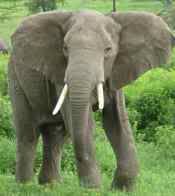
Crop-raiding by elephants creates a conundrum for conservationists and wildlife experts. The reduction in the territory available to elephants has led to instances in which elephants have been shot because of repeated crop-raiding. To protect both crops and elephants, rangers have been using tracking devices to notify them when an elephant is on the move toward a farm. And the technology used nowadays: cellular and SMS.

I remember the days when I would watch nature shows and see them tranquilize an animal and put a tracking collar on it. In those days they would use a VHF transmitting device, and they still do, at times, but nowadays they frequently use a collar with GPS / GSM technology.

While being used to track elephants to prevent crop raiding, it has a secondary use: preventing poaching, as rangers can focus their resources in the appropriate areas.

The new GPS/GSM tracking devices can be programmed to automatically take a GPS reading and send the information via SMS (text message). Not only that, Save the Elephants has partnered with Google, so they now track "their" elephants with Google Earth.

If you're interested, at the Save the Elephants site, you can download PDFs of tracking reports (example here).

The result of the tracking has been a drop in crop raiding. In Kenya, Basila Mwasu, a 31-year-old mother of two, used to have to drum through the night on pots and pans with her neighbors in front of flaming bonfires to frighten the elephants away.

OpenOffice 3.0 Starts

OpenOffice 3.0 Final to Launch Monday, But You Can Get It Now


OpenOffice.org is throwing a launch party in Paris on Monday, October 13th to mark the eighth anniversary of the open source office software suite and --- simultaneously --- to mark release of version 3.0. The launch event will be sponsored by the Region Ile de France, Silicon Sentier, and OpenOffice. The party is open to everyone, and registration is available online.
Note taking on Writer documents is now much more usableand more ...Open Office 3.0 is Available for the following platforms:
Linux
Mac OS (Intel)
Solaris Sparc
Solaris x86
Windows (32-bit)Can't want for Monday and want it now? There are a few sites such as MajorGeeks hosting the Windows version.In general, though, go to the page listing the OpenOffice.org mirrors, and you can usually find the images in openoffice/stable/3.0.0/on their FTP site. For example, here and here. The cautious can wait until Monday, but the rest of you, start downloading and start playing around with it.
Yesterday, we attended a Business Wire presentation. Business Wire is a Berkshire Hathaway Company (Public, NYSE:BRK.A). Did you know that?! We have used the services of the Business Wire over the years, but that association encouraged us to go - they must be good! We wonder how we missed the Warren Buffet connection. We asked them. We met a couple interesting people and understood just how far removed we were from their world. The topic was Web 2.0 and the tools they have developed to promote their customers as they want to be promoted. We would have shown this, but it may have been too much.

New technology tricks

'Old dog' outstays pups with new technology tricks

http://ftper.newsusa.com/Thumbnail/SundanceSpas_Hydrotherapy.jpg

Wellington production company Gibson Group invented, produced and installed the latest interactive display at Te Papa, a user-controlled media wall as part of the Our Space exhibit.

After more than 30 years in media production, Mr Gibson does not mind being called an old dog, and Gibson Group is one of the more respected in the game.

"We've also got some young pups around the kennel. You do have to reinvent yourself in this business," he says. "There are an awful lot of people my age that have vanished."

With 20 full-timers and at least 100 freelancers in the wings, Gibson Group has grown from Mr Gibson's first projects in the early 1970s. Since then, the competition has at least quadrupled, growing more than the amount of available work, he says.

"The company has changed quite a lot. We have always been pretty good at picking where it [technology trend] is going to go."

Gibson Group turns over about $10 million a year, but the work can fluctuate, with some projects worth up to $5 million, and constantly updating and reinventing can be expensive in a technology-intensive business. Mr Gibson cites a year-old $100,000 piece of kit that is all but gathering dust now.

Rumours of the demise of TV have been around for a while, but new media such as the Web are still working out how to make money to pay for high-quality productions, he says. For all the new tricks, it is basically the same game, he says.

Proton therapy for cancer

Bates researchers eye proton therapy for cancer

http://www.varian.com/media/oncology/proton/images/dose_confirmity.jpg
Researchers at MIT's Bates Linear Accelerator Center have begun a collaboration with Texas-based ProTom International to develop and test a new cancer treatment based on proton therapy.The fundamental idea is to harness the cell-killing power of protons -- the nuclei of hydrogen atoms -- to knock off cancer cells before the cells kill the patient. Protons are useful especially in cases where it is important to minimize damage to the surrounding healthy tissue. ProTom holds the exclusive U.S. rights for one such proton therapy system initially developed in Russia. The MIT-ProTom team aims to apply their results at ProTom cancer treatment centers beginning in 2010.

"We at Bates are excited to participate in a collaboration to improve proton beam therapy with the objective of more effective cancer treatment worldwide," said Robert Redwine, director of Bates and a professor of physics at MIT. The work will be performed under Redwine's direction. Bates is a part of MIT's Laboratory for Nuclear Science.

First beam in the LHC


First beam in the LHC - accelerating science

http://astronomyonline.org/aoblog/images/LHC.jpg
A historic moment in the CERN Control Centre "The beam was successfully steered around the accelerator in Geneva, 10 September 2008."

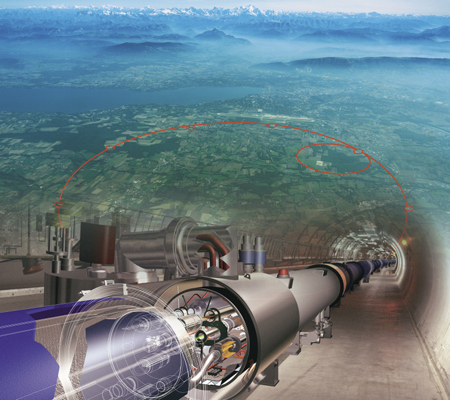
The first beam in the Large Hadron Collider at CERN1 was successfully steered around the full 27 kilometres of the world’s most powerful particle accelerator at 10h28 in morning at Geneva, 10 September 2008. This historic event marks a key moment in the transition from over 20 years of preparation to a new world of scientific discovery.

The Large Hadron Collider (LHC) — built since 2003 at a cost of $3.8 billion — will provide scientists with much greater power than ever before to smash the components of atoms in a bid to see how they are made.

“It’s a fantastic moment,” said LHC project leader Lyn Evans, “we can now look forward to a new era of understanding about the origins and evolution of the universe.”

Starting up a major new particle accelerator takes much more than flipping a switch. Thousands of individual elements have to work in harmony, timings have to be synchronized to under a billionth of a second, and beams finer than a human hair have to be brought into head-on collision. Today’s success puts a tick next to the first of those steps, and over the next few weeks, as the LHC’s operators gain experience and confidence with the new machine, the machine’s acceleration systems will be brought into play, and the beams will be brought into collision to allow the research programme to begin.
http://graphics8.nytimes.com/images/2007/05/14/science/15cern.xlarge1.jpg
The LHC, as the collider is known, will take scientists to within a split second of a laboratory recreation of the big bang, which they theorize was the massive explosion that created the universe.

The project organized by the 20 European member nations of CERN has attracted researchers of 80 nationalities. Some 1,200 are from the United States, an observer country which contributed $531 million. Japan, another observer, also is a major contributor.

The collider is designed to push the proton beam close to the speed of light, whizzing 11,000 times a second around the tunnel.

Smaller colliders have been used for decades to study the makeup of the atom. Less than 100 years ago scientists thought protons and neutrons were the smallest components of an atom's nucleus, but in stages since then experiments have shown they were made of still smaller quarks and gluons and that there were other forces and particles.

The CERN experiments could reveal more about "dark matter," antimatter and possibly hidden dimensions of space and time. It could also find evidence of the hypothetical particle — the Higgs boson — believed to give mass to all other particles, and thus to matter that makes up the universe.

Some scientists have been waiting for 20 years to use the LHC. But even their younger colleagues are excited that startup has finally arrived.

"I think it's a very important project," said Katie McAlpine, 23, a Michigan State University graduate who made a rap video about the project.

"It's mostly out of scientific curiosity, what is the universe made of? How does it work? What are the rules? That's very exciting and it's important to advance our knowledge," she told Associated Press Television News.

She said she was surprised by the success of the video, which has had more than a million views on YouTube and which has received approval from CERN for its scientific accuracy, especially in its success with young people.

"I was really hoping that this would get taken into classrooms," McAlpine said. "I don't imagine that elementary school and most middle school children will understand it very well, but a lot of parents have e-mailed me, saying I have a 9-year-old or a 7-year-old and showed them your rap and they really love it.


“The LHC is a discovery machine,” said CERN Director General Robert Aymar, “its research programme has the potential to change our view of the Universe profoundly, continuing a tradition of human curiosity that’s as old as mankind itself.”

“I am very honored to visit CERN, an invaluable scientific institution and a shining example what international community can achieve through joint efforts and contribution. I convey my deepest admiration to all the scientists and wish them all the success for their research for peaceful development of scientific progress.”-United Nations Secretary General, Ban Ki-moon said in a visit to CERN shortly before the LHC’s start-up.

“It has been a fascinating and rewarding experience for us,” said Vinod C. Sahni, Director of India’s Raja Ramanna Centre for Advanced Technology, “I extend our best wishes to CERN for a productive run with the LHC machine in the years to come.”

“The completion of the LHC marks the start of a revolution in particle physics,” said Pier Oddone, Director of the US Fermilab. “We commend CERN and its member countries for creating the foundation for many nations to come together in this magnificent enterprise. We appreciate the support that DOE and NSF have provided throughout the LHC's construction. We in the US are proud to have contributed to the accelerator and detectors at the LHC, together with thousands of colleagues around the world with whom we share this quest.”

“I congratulate you on the start-up of the Large Hadron Collider,” said Atsuto Suzuki, Director of Japan’s KEK laboratory, “This is a historical moment.”

“As some might say: ‘One short trip for a proton, but one giant leap for mankind!’ TRIUMF, and indeed all of Canada, is delighted to bear witness to this amazing feat,” said Nigel S. Lockyer, Director of Canada’s TRIUMF laboratory. “Everyone has been involved but CERN is to be especially congratulated for bringing the world together to embark on such an incredible adventure.”

powered by Blogger | WordPress by Newwpthemes | Converted by BloggerTheme