Showing posts with label Science. Show all posts

UDS, a Subsidiary of Delivery Technology Solutions

UDS, a Subsidiary of Delivery Technology Solutions, Inc. Announces Extension of the SUBWAY(R) Washington, DC Pilot Agreement

Courtesy :(BUSINESS WIRE)
-- Universal Delivery Solutions (UDS), a division of Delivery Technology Solutions, Inc. (Pink Sheets: DTSL), the leader in delivery management technology, has announced the extension of its agreement with Doctor's Associates Inc. (DAI), the parent of SUBWAY(R) Restaurants. The agreement will continue through December 31, 2010, for the 888-SUB-TO-GO(TM) program pilot that has been operating in the Washington, DC Metro area since Fall 2009. The announcement was made by Ryan Coblin, Delivery Technology Solutions, Inc, Chairman/CEO.
"We are pleased and encouraged by the extension of our agreement with DAI for SUBWAY(R) Restaurants in the Washington area," said Mr. Coblin, "and we view it as affirmation of the success we have had in implementing our proprietary technology and exclusive solutions in and around the nation's capital."
The 888-SUB-TO-GO(TM) services provide the convenience of both toll-free telephone Call Center ordering and Online Ordering at www.888subtogo.com. Customers can order from either the standard SUBWAY(R) menu, or the catering menu that features sandwich platters and giant 6-foot subs, and receive their delivery order, pre-ordered, per their scheduled requirements.
Washington, DC is the eighth largest Nielsen metro market, which includes parts of Northern Virginia and Maryland. Nearly 300 SUBWAY(R) Restaurants are participating in the pilot test program, offering residential and office catering and delivery seven days per week. Since its inception in Washington 888-SUB-TO-GO(TM) has registered a 99% customer approval rating on surveys conducted by the UDS Call Center.
"We are very grateful to the management of DAI for the extension of our mutual agreement," Mr. Coblin explained, "and also to the SDC Development Agent and the Washington market's Franchise Advertising Fund Board for their cooperation in bringing our 888-SUB-TO-GO(TM) services to their customers."
About SUBWAY(R) Restaurants
The SUBWAY(R) chain is the world's largest submarine sandwich franchise, with more than 32,690 locations in 91 countries. The SUBWAY(R) chain has surpassed McDonald's(R) number of locations throughout the USA, Canada, Australia and New Zealand. The SUBWAY(R) chain consistently ranks at the top of Entrepreneur magazine's Franchise 500(R) rankings. Besides being number one for the Submarine Sandwich Category, the SUBWAY(R) chain has received the distinction as being the number one Franchise Opportunity for 19 of the past 23 years! For more information about the SUBWAY(R) chain, visit www.subway.com. SUBWAY(R) and any other marks associated with the SUBWAY(R) Franchise System are the sole property of Doctor's Associates Inc.
About Universal Delivery Solutions
Universal Delivery Solutions, Inc. is the wholly owned subsidiary of Delivery Technology Solutions, Inc. (DTSL), www.deltechsol.com, the leader in providing comprehensive custom-developed catering & delivery solutions to industries throughout North America, including restaurants, retail and others. The company's solutions offer a seamless system that integrates Customer Relationship Management (CRM) and Call Center IT services through a proprietary technology backbone to offer convenience, consistent quality, flexibility, accountability and value for consumers and companies. 888-SUB-TO-GO(TM)is the trademark of Universal Delivery Solutions, Inc.
Safe Harbor:
The statements in the press release that relate to the company's expectations with regard to the future impact on the company's results from acquisitions or actions in development are forward-looking statements, within the meaning of the Private Securities Litigation Reform Act of 1995. The statements in this document may also contain "forward-looking statements" within the meaning of Section 27A of the Securities Act of 1933 and Section 21E of the Securities Exchange Act of 1934. Since this information may contain statements that involve risk and uncertainties and are subject to change at any time, the company's actual results may differ materially from expected results.
SOURCE: Delivery Technology Solutions, Inc.

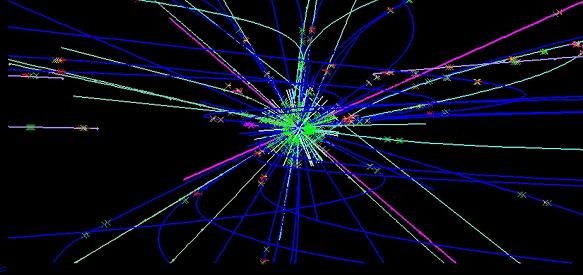
LHC to uncover dark secrets

Large Hadron Collider to uncover dark secrets soon

Large Hadron Collider to uncover dark secrets soon
Beams of protons circling around opposite directions collided at 7 TeV in the Large Hadron Collider (LHC) at 13.06, Geneva time; a historic moment. Never before man has reached such an energy ever in the history of science. The whole world is rejoicing and the scientific world is jubilant. It is not only a unique and great achievement but March 30 has also opened up a thousand windows of new concepts and new ideas that were until now shrouded in the darkest preserve of the nature.

There was no dearth of anxious moments. Beams started circling the night before without colliding – suddenly around 7 am there was no beam. Something went disastrously wrong. The proton simply refused to be pushed around. After some clever tricks, around 10.30 hours on March 30 the beam came up again.

Higgs Boson, dark matter candidates, source of dark energy, supersymmetric particles – all these fundamental questions are going to be addressed by the LHC. Further when the two nuclei will go on colliding modes shortly, we shall have a glimpse of the universe through the lens of mini bang, a microsecond after the Big Bang.

Technologically, LHC is a marvel at the same time it is the hottest (a million times the temperature of the interior of the Sun) as well as the coldest place (a couple of degrees Kelvin) in the universe, even colder than the microwave background radiation encompassing the entire cosmos. It is the hiss of the universe, the reminisce of its very creation in a Big Bang and therefore, the hiss of the expanding universe.

Already, the data coming out of the colliding protons are overflowing the computers at the detectors, ALICE, CMS, ATLAS and LHCb. The invention of GRID computing system, which networks all the computers in TIER 1 and 2 around the world, has been so fantastic that immediately after March 30, the facility has been fully operational. Kolkata VECC & SINP are members of the TIER 2.

Fundamental questions, which have bothered human beigns, are going to be addressed and examined critically – Why there is matter and not antimatter?; Is it possible for all the forces to be grandly unified?; What is the origin of mass?

Indeed when the nuclei collides in the near future and (hopefully) creates a plasma of quarks and gluons (the very fundamental building blocks of nature) we shall have much deeper insight in the very nature of strong interaction, that binds neutrons and protons inside the atomic nucleus.

Guido Tonelli, spokesperson of the CMS experiment says: “We’ll soon address some of the major puzzles of modern physics.” A collaboration spokesperson, Fabiola Gianotti says: “LHC experiments are propelled into a vast region to explore and the hunt begins for dark matter, new forces even new dimensions.”

In ALICE detector, Kolkata, VECC & SINP have made major contributions in terms of Photon Multiplicity Detector (PMD) and the “MANAS” chip of the dimuon spectrometre. Naturally, we are all jubilant to have already collected the newest data that man has ever seen. My friend Jurgen Schucraft, spokesperson of ALICE, puts it very aptly: “This is the moment we have been waiting and preparing for.”

The director general of Cern Rolf Heuer in a typically understated sentence tells us: “It is a great day to be a particle physicist.” Cern will run the LHC for 18-24 months with the objective of delivering enough data to the experiment make significant advances across a wide range of physics channels.

As soon as they have “re-discovered” the known standard model particles, a necessary precursor to looking for new physics, the LHC experiment will start the systematic search for the Higgs Boson. With the amount of data expected, called one inverse femtobarn by physicists, the combined analysis of ATLAS and CMS will be able to explore a wide mass range.

Heuer explains: “The LHC has a real chance over the next two years of discovering supersymmetric particles and possibly giving insights into the composition of about a quarter of the universe.”

“Over 2,000 graduate students are eagerly awaiting data from the LHC experiments,” Heuer says. “The privileged bunch is set to produce the first theses at the new high-energy frontier. Two years of continuous running is a tall order both for the LHC operators and the experiments, but it well worth the effort.”

Clearly, a moment has come when the young can make their mark and may become famous for more than fifteen minutes. I say “The world will not be same again.” I further say, “LHC will bring up man to a very different height scientifically and technologically. The LHC has touched men and women of countries across the world of all ages as never before.”

The writer is former director of Saha Institute of Nuclear Physics and at present Homi Jehangir Bhabha distinguished chair professor at Department of Atomic Energy

LHC discovered !

Beauty with antimatter bottom' created out of pure energy

 LHCb Beauty particle collision graphics. Credit: CERN
By Lewis Page • Get more from this author
Physicists at the Large Hadron Collider (LHC), the most powerful particle punisher ever assembled by the human race, say that experiments there are going well. In particular, they have managed to create out of pure energy a thing which they describe as a "beauty" featuring an antimatter bottom.
The unbelievably tiny creation was picked up this week by assiduous boffins trawling through some ten million pics taken by the vast LHCb experiment situated deep underground on the subterranean superchilled superconducting supermagnet proton-ring circuit of the Collider, just outside Geneva.
According to the LHCb scientists:
LHCb has reconstructed its first Beauty Particle! The Beauty Particle (called B+) is composed of an anti-quark b (that has a very short lifetime of 1.5 thousandth of a nanosecond!) and a quark u.
The quark b is known in some circles as a "bottom" quark, so this is plainly an anti-bottom.*
It seems that the B+ beauty was produced by the head-on collision of two protons travelling at light speed, rammed into one another by the crossing of the LHC's twin opposing proton ring beams within the LHCb detecto-cavern complex.
If we're following the scientists' explanation correctly*, the newly created B+ actually had about five times as much mass as the two protons which had crashed into one another to call it into being: in effect, most of the beauty sprang out of nowhere during the collision as the outrageous energies carried by the LHC's colliding particle beams were converted into mass, in a reversal of the process which turns the Sun's matter into sunlight.
"Yes, we can create mass from energy using the famous Einstein formula E=mc2," report the LHCb boffins, with pardonable smugness.
They proved this by working out that the beauty with the antimatter bottom, after travelling about 2 millimetres, exploded and turned into a shower of other subatomic gumble including a Kaon (which is, as any fule kno, one of four types of meson whose strangeness is non-zero) and a thing known as an "excited charmonium". The latter then came to bits again again, as you'd expect, into a muon and an anti-muon.
By some process involving extremely hard sums and possibly some type of reinforced, extremely close-fitting hat to prevent their heads exploding (we could do with one of those just writing about it) the boffins managed to identify all of this on the mad snakes' wedding of particle tracks pictured above and add up how much the original antibottomed beauty had weighed (5.32 Giga-electron-Volts, in case you're wondering) pleasingly confirming that they had indeed summoned matter - and antimatter - into existence using only French and Swiss grid electricity.
Quite apart from being good clean fun, boffins hope that this sort of business will solve the so-called "puzzling antimatter" problem, namely: where is all the antimatter?
According to physics, antimatter and regular stuff should have been created in equal amounts at the Big Bang, yet somehow we've managed to arrive at a universe full of regular-flavour matter and pretty much no antimatter at all.
According to CERN boffins this means that pretty much the whole of physics is wrong, which seems to be pretty much normal for physics:
Since the disappearance of primordial antimatter cannot be explained by the current Standard Model theory, it is clear that we have to look for something new. Scientists are exploring different avenues but, given the fact that what we observe represents only about 4% of the total energy and matter that the Universe is made of, one can guess that part of the key to solving the antimatter mystery could be held in the yet unknown part of the Universe.
Apparently the key to the business involves looking into something called "CP-violation", which is some sort of deviance from normal behaviour on the part of antibottom beauties and their relatives - thus the more of them that can be created at the LHC, the sooner the missing 96 per cent of the universe can be tracked down - perhaps hidden in another dimension or something.

Best Colleges in Pakistan

1. College of Accounting & Management Science
Courses:
College of Accounting & Management Science
Located at 109 - B Gulshan-E-Fasial, Bath Island Clifton, Karachi - 75530
Ph: 5837108-9, Fax: 5834783


School Information Page ACCA, CAT, B.COM, MFC, Inter Commerce, Inter Science

2. PUCIT Courses:
PUCIT
Information Technology College of Punjab University situated in heart of Lahore, Pakistan.

School Information Page BSc Computer Science, MSc Computer Science, Ph.D Computer Science BIT, MIT, Master in Economics, M.Sc GIS

3. COMSATS Institute of Information Technology Courses:
COMSATS Institute of Information Technology
COMSATS Institute of Information Technology (CIIT), one of the leading public sector IT institutes in Pakistan, became functional in 1998 , and attained the status of degree awarding institute on 12th August, 2000. Currently CIIT is imparting education to over 5000 students nationwide. With its headquarters in Islamabad, CIIT also has campuses at Lahore, Wah , Abbottabad and Attock. The international hiring of the highly qualified faculty is being done with the active administrative and financial support from the Higher Education Commission (HEC) of Pakistan.

School Information Page Mathematics, Physics, Management Science, Development Studies, Environmental Sciences, Computer Science, Computer Engineering, and Electrical Engineering. The newly emerging fields span Telecommunication Engineering, Electronics Engineering and Bioinformatics. The academic programs are offered at the Bachelor, Master’s, and post Masters levels leading to MS and Ph.D. degrees.

4. Institute of Business Administration Courses:
Institute of Business Administration
The Institute of Business Administration (IBA) in Karachi is one of the leading business schools in Pakistan and this part of the world. IBA programs are designed to provide world-class professional managers and entrepreneurs for the business and industry in Pakistan. Distinguishing features of the IBA are the induction of students through a systematic and merit-based admission process, training in a demanding academic environment, and on-time completion of study programs. The Institute of Business Administration (IBA) and Microsoft recently entered into a strategic alliance, substantially increasing the institute’s access to latest software technologies and computer knowledge base.

School Information Page Include MBA - Master of Business Administration with specialization in fields of Management, Human Resource Management, Finance, Banking, Marketing and Management Information Systems. BBA Degree, Bachelor of Computer Studies -BCS, Postgraduate Diploma, Certificate Courses, Executive Education

5. National College of Arts Courses:
National College of Arts
Since 1963 when the present National College of Arts, Lahore was invested with a new arts structure, it has carried courses in three departments, Architecture, Fine Arts and Design. All these courses are professional and enable the graduate to relate his talent to the job market. In 1985, through an ordinance the college has been granted the status of an autonomous degree awarding institution and now awards Bachelor Degrees in Fine Arts, Design and Architecture. The ordinance also empowers the institution to institute postgraduate programmes in the field of Visual Arts. Acknowledging the necessity of excelling in the field of Information Technology, the college initiated another post-graduate programme in Multimedia Arts in Sept 2001. The college is also offering Masters Degree in Interior Design.

School Information Page
UnderGraduate: Fine Arts, Communication Design, Ceramics Design, Product Design, Textile Design, Architecture, Musicology, Film and Television. Post Graduate: Visual Arts, Interior Arts, Multimedia, M.Phil/Ph.D, Short Courses: Media Productions, Workshops

6. Institute of Management and Sciences Courses:
Institute of Management and Sciences
Located in Lahore, Pak-AIMS's unceasing, persistent and untiring effort for quality education and exemplary discipline finally culminated in its gracious recognition in the form of a charter by the name of The Institute of Management Sciences (IMS), from the Punjab Government in the last week of February 2002. The Pak-AIMS Board of Governors, faculty and staff received this news with immense pleasure and prayed for the further growth and development of the institution.

School Information Page
MBA, BBA, MS, MCS, BSCS, BCS, LLB, PGD Java Enterprise Developer, IELTS Training

7. Faisalabad Institute of Textile & Fashion Design Courses:
Faisalabad Institute of Textile & Fashion Design
Located in Faisalabad, the Faisalabad Institute of Textile & Fashion Design it is a school established with great vision of Art & Design to fulfill all requirments of growing industry. Faisalabad Institute of Textile & Fashion Design is a non-profit organization working under the support and contribution of the textile sector of Faisalabad. This new University is going to bridge the gap between the industry & the academia. This is the first Institute in Pakistan which has been established with a firm commitment and the support of Government to provide the quality education in the field of Textile, Fashion and Graphic Design. Industrial concessions & 100% Job Placement.

crescent bahria cadet college khi pakistan.


Hitachi Hard Drives

Hitachi unveils new CinemaStar hard drives

Hitachi announced two new CinemaStar hard drive models. The new 3.5-inch hard drives are the CinemaStar 7K1000.B and the CinemaStar 5K320 which are intended to be used in digital video recorders (DVRs). The CinemaStar 7K1000.B is available up to 1TB capacity, while the CinemaStar 5K320 has 320GB storage capacity.

The 5K320 uses CoolSpin technology which Hitachi claims is one of the most power efficient and quiet hard drive available in the market today. CoolSpin technology consists of a motor that is speed optimized for low power and quiet operation.

Hitachi says that the 1TB CinemaStar 7K1000.B can store up to 247 hours of MPEG-4 encoded high definition video and support up to ten simultaneous data streams. The CinemaStar 7K1000.B will be available in August and the 5K320 will ship in September.

Google's New Project

Google attempts to produce renewable energy cheaper than coal

Search giant Google on Tuesday pledged to spend hundreds of millions of dollars to make renewable energy cheaper than coal.

The push to mitigate the effects of climate change through clean energy falls squarely into Google.org's missions to improve human health and alleviate poverty, said Larry Brilliant, the executive director of Google.org.

The effort, dubbed RE Technologies created by Google will likely be used by Google, whose data centers are voracious consumers of electricity. The company envisions either selling electricity from renewable sources or licensing technology on terms that would promote broad adoption, according to company founders Larry Page and Sergey Brin.

Its overarching goal is to produce 1 gigawatt of electricity from renewable sources--enough to power the city of San Francisco--faster than the current pace of green-technology development.

"The main crux of this is that we believe that you can do it cheaper than coal...and we want to make it happen now," said Page, Google's president of products. "Most people who are doing this now are trying to do it less expensive than people before, but they are not trying for that goal which will have a significant effect on the world."

Investments in other companies will be funded by Google's philanthropic arm, Google.org, which has about $2 billion worth of Google stock available to it.

In particular, Google will be investing in solar-thermal technology, wind power, and geothermal systems. Its target is to fall below the price of coal power generation, which can be as low as 2.5 cents per kilowatt-hour, said Bill Weihl, Google's green-energy czar.

Google said it's already working with eSolar, a solar-thermal company building systems for utilities to generate electricity from heat. It has invested in Makani Power, which is pursuing electricity generation by harnessing wind at high altitudes.

As part of the effort, Google will be hiring experts in the energy field. It expects to hire 20 to 30 people into its clean-energy division in the next year. More substantial investments will come as energy projects come online, Weihl said.

Although an ambitious plan, Google's impact on the clean-tech market segment in the near term is likely to be more psychological than financial, said Paul Clegg, a senior equity analyst who follows clean tech at Jefferies.

"Tens of millions of dollars is not a small number, obviously, but you're spreading that over things that a lot of other companies are attacking on an individual basis with more money going at it," Clegg said. "I think they'd have to invest a lot more money to get the next Manhattan Project going."

However, Google's initiative is significant in that it could indicate how corporations will start addressing their energy needs and climate change going forward, he said.

Eclipse

Eclipse enthusiasts rejoice in August


The March 29, 2006 eclipse seen from Accra, Ghana.
Olivier Asselin / AP


In Friday, August 1 the sun will be partially eclipsed over an immense area that includes western and central Asia, parts of northern and central Europe, all of Greenland and even a small slice of northeastern North America.

A total solar eclipse — the first in nearly two and a half years — will be visible along a narrow track that will start over the Northwest Passage of Canada, gives a glancing blow to northern Greenland, then shifts southeast through Siberia and western Mongolia and before ending near the famed Silk Route of China.

The path of totality for this upcoming eclipse is never more than 157 miles (252 km) wide.

Science -Tech Encyclopedia: Textile

A material made mainly natural or synthetic fibers. Modern textile production may be prepare from number of combinations of fibers, foams, furs, or leather, yards, films, sheets,. They are found in apparel, household and commercial furnishings, vehicles, and industrial products. See also Manufactured fiber; Natural fiber.
Cloth as a thin, flexible material made from yarns; yarn as a continuous strand of fibers; and fiber as a fine, rod like object in which the length is greater than 100 times the diameter. The bulk of textile products are made from cloth.

The natural progression from raw material to finished product requires: the cultivation or manufacture of fibers; the twisting of fibers into yarns (spinning); the interlacing (weaving) or interloping (knitting) of yarns into cloth; and the finishing of cloth prior to sale.

The process of weaving allows a set of yarns running in the machine direction (warp) to be interlaced with another set of yarns running across the machine (filling or weft). The weaving process involves four functions: shedding (raising the warp yarns by means of the appropriate harnesses); picking (inserting the weft yarn); battening (pushing the weft into the cloth with a reed); and taking up and letting off (winding the woven cloth onto the cloth beam and releasing more warp yarn from the warp beam;

Construction design for plain weave; filling yarns pass under and over alternate warp yarns, as shown at right. When fabric is closely constructed, there is no distinct pattern. (After M. D. Potter and B. P. Corpsman, Fiber to Fabric, 3d ed., McGraw-Hill, 1959)

Three-shaft twill. Two warp yarns are interlaced with one filling yarn. (After M. D. Potter and B. P. Corpsman, Fiber to Fabric, 3d ed., McGraw-Hill, 1959
Three-shaft twill. Two warp yarns are interlaced with one filling yarn. (After M. D. Potter and B. P. Corpsman, Fiber to Fabric, 3d ed., McGraw-Hill, 1959)

Interlocking yarns of (a) course and (b) wale in a Jersey knit cloth. (After B. P. Corpsman, Fiber to Fabric, 5th ed., McGraw-Hill, 1975)

Single-warp (one-bar) tricot knit. (After B. P. Corpsman, Fiber to Fabric, 5th ed., McGraw-Hill, 1975)

Newly constructed knit or woven fabric must pass through various finishing processes to make it suitable for its intended purpose. Finishing enhances the appearance of fabric and also adds to its serviceability. Finishes can be solely mechanical, solely chemical, or a combination of the two. Those finishes, such as scouring and bleaching, which simply prepare the fabric for further use are known as general finishes. Functional finishes, such as durable press treatments, impart special characteristics to the cloth. For discussions of important finishing operations See also Bleaching; Dyeing; Textile chemistry; Textile printing.

powered by Blogger | WordPress by Newwpthemes | Converted by BloggerTheme