Showing posts with label Science News. Show all posts

First beam in the LHC


First beam in the LHC - accelerating science
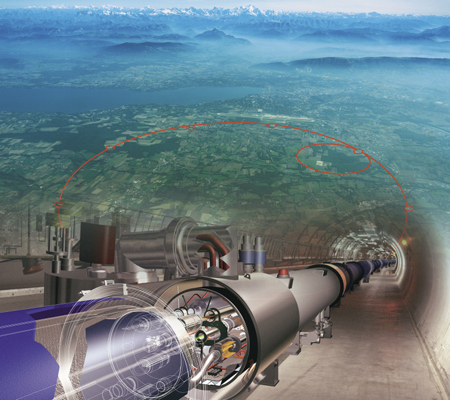
http://astronomyonline.org/aoblog/images/LHC.jpg
A historic moment in the CERN Control Centre "The beam was successfully steered around the accelerator in Geneva, 10 September 2008."

The first beam in the Large Hadron Collider at CERN1 was successfully steered around the full 27 kilometres of the world’s most powerful particle accelerator at 10h28 in morning at Geneva, 10 September 2008. This historic event marks a key moment in the transition from over 20 years of preparation to a new world of scientific discovery.

The Large Hadron Collider (LHC) — built since 2003 at a cost of $3.8 billion — will provide scientists with much greater power than ever before to smash the components of atoms in a bid to see how they are made.

“It’s a fantastic moment,” said LHC project leader Lyn Evans, “we can now look forward to a new era of understanding about the origins and evolution of the universe.”

Starting up a major new particle accelerator takes much more than flipping a switch. Thousands of individual elements have to work in harmony, timings have to be synchronized to under a billionth of a second, and beams finer than a human hair have to be brought into head-on collision. Today’s success puts a tick next to the first of those steps, and over the next few weeks, as the LHC’s operators gain experience and confidence with the new machine, the machine’s acceleration systems will be brought into play, and the beams will be brought into collision to allow the research programme to begin.
http://graphics8.nytimes.com/images/2007/05/14/science/15cern.xlarge1.jpg
The LHC, as the collider is known, will take scientists to within a split second of a laboratory recreation of the big bang, which they theorize was the massive explosion that created the universe.

The project organized by the 20 European member nations of CERN has attracted researchers of 80 nationalities. Some 1,200 are from the United States, an observer country which contributed $531 million. Japan, another observer, also is a major contributor.

The collider is designed to push the proton beam close to the speed of light, whizzing 11,000 times a second around the tunnel.

Smaller colliders have been used for decades to study the makeup of the atom. Less than 100 years ago scientists thought protons and neutrons were the smallest components of an atom's nucleus, but in stages since then experiments have shown they were made of still smaller quarks and gluons and that there were other forces and particles.

The CERN experiments could reveal more about "dark matter," antimatter and possibly hidden dimensions of space and time. It could also find evidence of the hypothetical particle — the Higgs boson — believed to give mass to all other particles, and thus to matter that makes up the universe.

Some scientists have been waiting for 20 years to use the LHC. But even their younger colleagues are excited that startup has finally arrived.

"I think it's a very important project," said Katie McAlpine, 23, a Michigan State University graduate who made a rap video about the project.

"It's mostly out of scientific curiosity, what is the universe made of? How does it work? What are the rules? That's very exciting and it's important to advance our knowledge," she told Associated Press Television News.

She said she was surprised by the success of the video, which has had more than a million views on YouTube and which has received approval from CERN for its scientific accuracy, especially in its success with young people.

"I was really hoping that this would get taken into classrooms," McAlpine said. "I don't imagine that elementary school and most middle school children will understand it very well, but a lot of parents have e-mailed me, saying I have a 9-year-old or a 7-year-old and showed them your rap and they really love it.


“The LHC is a discovery machine,” said CERN Director General Robert Aymar, “its research programme has the potential to change our view of the Universe profoundly, continuing a tradition of human curiosity that’s as old as mankind itself.”

“I am very honored to visit CERN, an invaluable scientific institution and a shining example what international community can achieve through joint efforts and contribution. I convey my deepest admiration to all the scientists and wish them all the success for their research for peaceful development of scientific progress.”-United Nations Secretary General, Ban Ki-moon said in a visit to CERN shortly before the LHC’s start-up.

“It has been a fascinating and rewarding experience for us,” said Vinod C. Sahni, Director of India’s Raja Ramanna Centre for Advanced Technology, “I extend our best wishes to CERN for a productive run with the LHC machine in the years to come.”

“The completion of the LHC marks the start of a revolution in particle physics,” said Pier Oddone, Director of the US Fermilab. “We commend CERN and its member countries for creating the foundation for many nations to come together in this magnificent enterprise. We appreciate the support that DOE and NSF have provided throughout the LHC's construction. We in the US are proud to have contributed to the accelerator and detectors at the LHC, together with thousands of colleagues around the world with whom we share this quest.”

“I congratulate you on the start-up of the Large Hadron Collider,” said Atsuto Suzuki, Director of Japan’s KEK laboratory, “This is a historical moment.”

“As some might say: ‘One short trip for a proton, but one giant leap for mankind!’ TRIUMF, and indeed all of Canada, is delighted to bear witness to this amazing feat,” said Nigel S. Lockyer, Director of Canada’s TRIUMF laboratory. “Everyone has been involved but CERN is to be especially congratulated for bringing the world together to embark on such an incredible adventure.”

Intel Chipsets

Apple to skip Intel Chipsets in new MacBook lineup?

Apple’s jump into the Intel bandwagon has been very beneficial for the company when it comes to sales. However, there are rumors that Apple will no longer include intel chipset in their future MacBooks. According to rumors, Apple might develop its own chipset or perhaps look for a suitable alternatives like NVidia chipsets.

While Intel has successfully ventured into mobile processors from Pentium M to Core 2 Duo, the company is less successful when it comes to integrated graphics chipsets that connect those processors to the rest of the system. Apple MacBook is using Intel’s mobile Centrino chipsets, but according to a report, Apple is going to pass on the Montevina version of those chipsets.

Let’s wait and see in the coming weeks if the rumors are true, the good news is that Apple will not be moving away from Intel processors.

Hitachi Hard Drives

Hitachi unveils new CinemaStar hard drives

Hitachi announced two new CinemaStar hard drive models. The new 3.5-inch hard drives are the CinemaStar 7K1000.B and the CinemaStar 5K320 which are intended to be used in digital video recorders (DVRs). The CinemaStar 7K1000.B is available up to 1TB capacity, while the CinemaStar 5K320 has 320GB storage capacity.

The 5K320 uses CoolSpin technology which Hitachi claims is one of the most power efficient and quiet hard drive available in the market today. CoolSpin technology consists of a motor that is speed optimized for low power and quiet operation.

Hitachi says that the 1TB CinemaStar 7K1000.B can store up to 247 hours of MPEG-4 encoded high definition video and support up to ten simultaneous data streams. The CinemaStar 7K1000.B will be available in August and the 5K320 will ship in September.

Lenovo Y410 T5550 Laptop

Lenovo Y410 T5550 Laptop,With a budget range from Php 40,000.00 (US$ 930.00) – Php 50, 0000.00 (US$ 1, 163.00), with exchange rate US$1 = Php 43.00, my hunt for an all purpose laptop was quite tough. I was looking for a laptop that can be used in almost all purposes – for photo and video editing, for gaming, for entertainment, for personal and business use, in other words, I was considering an all purpose laptop. If my budget was big enough, this could have been easily solved by purchasing superior laptops with high prices. But things were different; I had to find a laptop within the range of my budget. My hunt for a laptop started with price canvassing in local stores and in some online stores, keeping in mind my budget. Then, I had read several reviews of the laptops of the laptops that fit my budget range. After thorough readings in magazines and different review sites, finally, I had decided to choose Lenovo Y410 T5550. I purchased in a local store the Lenovo Y410 T5550 for Php 44, 450.00 (US$ 1, 034.00). I was lucky to have a discount since the original suggested retailed price and even the online price, is Php 49, 995.00 (US$1, 046.00). The complete specifications and features of Lenovo Y410 T5550, which I had purchased, are the following:

- Intel Centrino Core2 Duo T5550 1.83GHz Processor.

- Intel PRO / Wireless 3945ABG.

- Intel X3100 256MB Shared Display with Dual View & TV-Out.

- 14.1″ WideScreen WXGA with VibrantView.

- 2.0GB DDR2 Memory.

- 160GB SATA Hard Disk Drive.

- Slot-In RAMBO DVD±RW/DL/RAM Super Multi Drive.

- 100Mbps LAN, 56K Modem, Firewire, Bluetooth,

- Webcam 1.3 Megapixel, with VeriFace Technology

- PCMCIA & Card Reader.

- 2×1.5W Stereo Multimedia Speakers & 1×2W SubWoofer Speaker.

- Support Dolby® Home Theater™ Surround Sound.

- Shuttle Control & Shuttle Centre.

- Audio-DJ Control Panel.

- Weight: 2.3kg include 6-Cell Li-Ion Battery.

- It comes with a Lenovo Carrying Case and with One Year Warranty!

The Lenovo Y410 features one of the most innovative login methods. It makes good use of the built-in 1.3 megapixel Webcam combined with the VeriFace face recognition software. With these, your face is your password. The technology works fine, however, I have to honestly say that you need to login using your password at dark rooms or places since it cannot authenticate your face when there is no enough lights.

The Lenovo Y410 is packed with a Dolby Audio System. It has an outstanding surround sound with subwoofer for a better multimedia experience. I agree in some point, the quality of sound, indeed is excellent; however, the full volume isn’t really that loud. When you are watching a movie or listening to a song and when vehicles pass by especially if your home is situated near the roads, I guess you need supplementary speakers. I don’t have any problem with this; I have my Altec Lansing Speakers, which I bought 5 years ago, now I used them well. But, oops, it’s not really that low that you really can’t hear, in fact when having an online talk with my brother who is working abroad, I even don’t use any extra speaker and I can hear him clearly. Also, with regards to its built in microphone, it’s excellent since my voice is clearly heard by my brother. He was even surprised during one of our chatting sessions when he saw me at the web camera without using any headphones and a microphone, when in fact he is using one with his Acer laptop.

Although, this is my first laptop but this is not my first use of a laptop. Several laptops I had used before had uncomfortable and hard to press keyboards. However, with Lenovo Y410 T5550, I feel very comfortable with the ergonomic keyboard designed with outstanding feel and durability.

Lenovo is also featured with Shuttle Key. You can easily control your volume with equalizer presets for your favorite sound. I love this orange key which you can find at the upper right corner of the keyboard.

It is also ready with what they call Audio DJ where you can control and play CD’s without having to boot up the system. I find this feature fantastic.

Although, I have not experienced of a crashed system, but I don’t have to worry since Lenovo has a OneKey Recovery to recover the system at the touch of a button. But you must take in mind that in the event of failure, hitting the recovery button will reload the system to its factory default state. Since there might be tendency not to save all your personal data and files, following good backup practices is suggested and using the OneKey Recovery as a final option. You can use DVD for backing up files since Lenovo comes with a Slot-In RAMBO DVD±RW/DL/RAM Super Multi Drive.

Google's New Project

Google attempts to produce renewable energy cheaper than coal

Search giant Google on Tuesday pledged to spend hundreds of millions of dollars to make renewable energy cheaper than coal.

The push to mitigate the effects of climate change through clean energy falls squarely into Google.org's missions to improve human health and alleviate poverty, said Larry Brilliant, the executive director of Google.org.

The effort, dubbed RE Technologies created by Google will likely be used by Google, whose data centers are voracious consumers of electricity. The company envisions either selling electricity from renewable sources or licensing technology on terms that would promote broad adoption, according to company founders Larry Page and Sergey Brin.

Its overarching goal is to produce 1 gigawatt of electricity from renewable sources--enough to power the city of San Francisco--faster than the current pace of green-technology development.

"The main crux of this is that we believe that you can do it cheaper than coal...and we want to make it happen now," said Page, Google's president of products. "Most people who are doing this now are trying to do it less expensive than people before, but they are not trying for that goal which will have a significant effect on the world."

Investments in other companies will be funded by Google's philanthropic arm, Google.org, which has about $2 billion worth of Google stock available to it.

In particular, Google will be investing in solar-thermal technology, wind power, and geothermal systems. Its target is to fall below the price of coal power generation, which can be as low as 2.5 cents per kilowatt-hour, said Bill Weihl, Google's green-energy czar.

Google said it's already working with eSolar, a solar-thermal company building systems for utilities to generate electricity from heat. It has invested in Makani Power, which is pursuing electricity generation by harnessing wind at high altitudes.

As part of the effort, Google will be hiring experts in the energy field. It expects to hire 20 to 30 people into its clean-energy division in the next year. More substantial investments will come as energy projects come online, Weihl said.

Although an ambitious plan, Google's impact on the clean-tech market segment in the near term is likely to be more psychological than financial, said Paul Clegg, a senior equity analyst who follows clean tech at Jefferies.

"Tens of millions of dollars is not a small number, obviously, but you're spreading that over things that a lot of other companies are attacking on an individual basis with more money going at it," Clegg said. "I think they'd have to invest a lot more money to get the next Manhattan Project going."

However, Google's initiative is significant in that it could indicate how corporations will start addressing their energy needs and climate change going forward, he said.

Mars ice evidence

Mars ice evidence may arrive this week

Researchers hope for confirmation Monday that icy Martian soil has been delivered to an instrument on the Phoenix Mars Lander for analysis.
If the delivery is successful, scientists could have chemical evidence of Martian water ice this week, with proof of carbon, hydrogen and other elements coming later.
"It would be a revelation, change entirely the way we think about Mars," said Peter Smith, principal investigator.
An icy sample rasped, scraped, collected and delivered to the Lander's Thermal and Evolved-Gas Analyzer overnight Friday stuck in the craft's robotic arm scoop and failed to fall into an open TEGA oven door, images received Saturday showed.
Not enough of the sample reached the tiny oven - about the thickness of a pencil lead and 1 inch long - for analysis to take place, Sara Hammond, the University of Arizona-led mission's public affairs manager, said Sunday.
Images received Sunday morning showed the scoop empty. The stuck material had fallen on the Lander's deck, over which the scoop was left inverted following the failed TEGA delivery attempt.
Scientists ordered the Lander to rasp, scrape, collect a nd deliver another sample to TEGA Sunday, Hammond said.
If enough material reaches the TEGA oven, it will close and begin analysis, which will take a few days, she said.
Sunday's delivery attempt reduced the time the rasp is used to drill into the hard-as-concrete frozen Martian dirt.
Researchers were not sure why the icy material stuck in the scoop, Hammond said. One possibility is that the motorized rasp melted the ice, causing it to stick.
The scoop will sprinkle the material onto a screen with 1 millimeter openings protecting the TEGA oven, said William Boynton, lead TEGA scientist.
TEGA bakes and sniffs the material - heating it up to 1 ,800 degrees Fahrenheit - and analyzes the gases given off for water, hydrogen, carbon and other components that could show if the area is or was habitable.
Because water ice sublimates, or evaporates, on Mars, the sample must be rasped, scooped, collected and delivered within 30 minutes, Smith said.
The procedure has been practiced many times, on Mars and in a Tucson Payload Interoperability Testbed featuring a full scale engineering model of the Lander and a realistic Martian landscape, Smith said.

Eclipse

Eclipse enthusiasts rejoice in August


The March 29, 2006 eclipse seen from Accra, Ghana.
Olivier Asselin / AP


In Friday, August 1 the sun will be partially eclipsed over an immense area that includes western and central Asia, parts of northern and central Europe, all of Greenland and even a small slice of northeastern North America.

A total solar eclipse — the first in nearly two and a half years — will be visible along a narrow track that will start over the Northwest Passage of Canada, gives a glancing blow to northern Greenland, then shifts southeast through Siberia and western Mongolia and before ending near the famed Silk Route of China.

The path of totality for this upcoming eclipse is never more than 157 miles (252 km) wide.

powered by Blogger | WordPress by Newwpthemes | Converted by BloggerTheme